
What Is a Node in Networking? A Plain-English Guide
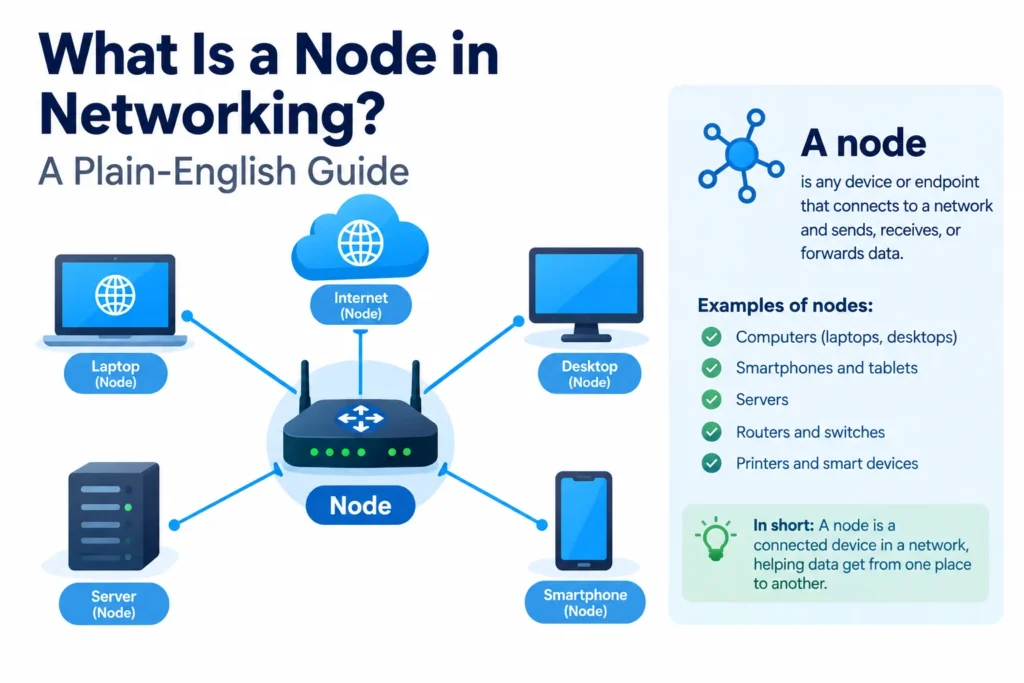
Your laptop is a node. So are your phone, your printer, and that router blinking in the corner. The idea is simple, and this guide covers it plainly, plus the few quirks that trip up students.
What is a node in networking?
A node is any device or connection point on a network that can send, receive, or pass along data. Computers, phones, printers, servers, switches, and routers all count. Each one gives the network a spot where information can enter, leave, or change direction.
Mozilla’s developer glossary puts it briefly: a node is a connection point, and on physical networks it’s usually a device like a computer or router. NIST describes a network as a collection of interconnected components, such as routers, hubs, and cabling. Combine the two, and the picture is clear. The network is the whole web. Each junction is a node. The lines between junctions are links, like Ethernet cables, Wi-Fi signals, or fiber.
Every active node does at least one of three jobs:
- Create data: your phone sends a photo.
- Receive data: a printer accepts a print job.
- Forward data: a router passes packets toward their destination.
Many do all three.
Types of network nodes
Most textbooks sort nodes into three groups.
End nodes are where data starts or finishes: laptops, tablets, phones, printers, and smart thermostats.
Intermediate nodes steer traffic without writing the message. A switch moves data between devices on the same network. A router connects that network to others, including the internet.
Server nodes are central machines that hand out resources such as web pages, files, or email.
Here’s a home example. Your laptop and phone are end nodes. The Wi-Fi router is an intermediate node. Open a video, and the request leaves your laptop, crosses the router, travels across the internet, and lands at a streaming company’s server. The video returns along the same route. One click, all three node types.
Which group does a device belong to? Sometimes it depends on the moment. A laptop sharing a folder is briefly acting like a server.
Does every node need an address?
Usually, yes. Nodes are identified by an IP address, a MAC address, or both, and that’s how data finds the right destination. Wikipedia’s entry adds a wrinkle, though. It says equipment operating only below the data link layer, such as a basic hub, doesn’t need a network address, and it says passive gear like a patch panel isn’t a node at all.
So which answer do you write on a test? Textbooks vary, and I can’t promise yours matches. A safe rule: active devices that send, receive, or forward data are nodes; passive cabling and panels aren’t. Treat the address requirement as a strong default, not a law.
Node vs. host vs. endpoint
These words overlap, which is why they confuse people.
| Term | Meaning | Example |
|---|---|---|
| Node | Any active connection point on a network | Router, laptop, printer |
| Host | A node that is the source or destination of data | Laptop, web server |
| Endpoint | A node where communication starts or ends | Phone, printer |
| Link | The connection between nodes, not a node itself | Ethernet cable, Wi-Fi signal |
The shortcut: every host is a node, but not every node is a host. A switch is a node that usually isn’t a host, because data rarely starts or ends there.
Same word, different meanings
“Node” shows up all over IT. Check which one you’re dealing with:
- Node.js: a JavaScript runtime for running code outside a browser. Not a network device.
- Blockchain node: a computer that holds a copy of the ledger. NIST’s glossary describes it as an individual system within the blockchain network.
- Kubernetes node: a machine, physical or virtual, that runs containers.
- Graph theory node: a point joined to others by edges. Network diagrams borrow this idea, which explains why the term stuck.







1 thought on “What Is a Node in Networking? A Plain-English Guide”