
What Does “Zero Proof” Actually Mean?
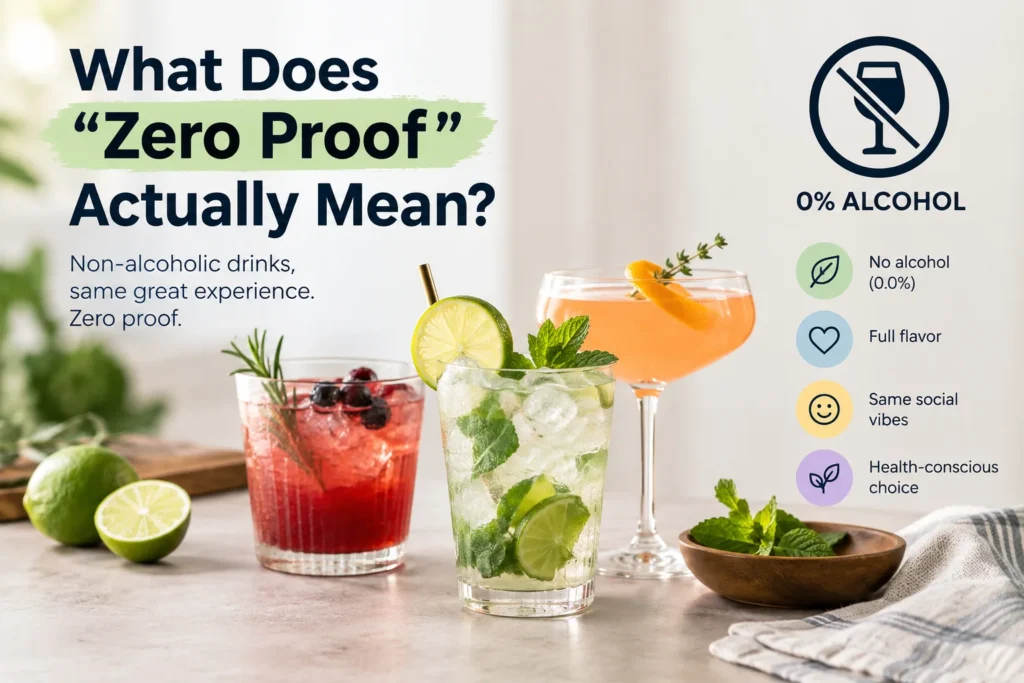
Order a “zero proof” cocktail, and you might expect something close to a soda with a garnish. That’s not quite it. The term has a specific meaning, and it’s stricter than most of the labels sitting next to it on a shelf.
The Short Answer
Zero proof means a drink contains 0.0% alcohol by volume (ABV). No trace amount, no rounding down, no asterisk. The word “proof” is a holdover from how spirits have historically been measured: in the US, proof is simply double the ABV, so an 80-proof whiskey is 40% ABV. Run that math backward, and zero proof lands exactly where it sounds like it should, at zero.
That precision matters, because “zero proof” gets used almost interchangeably with “non-alcoholic,” and the two aren’t legally the same thing.
Zero Proof vs. Non-Alcoholic vs. Mocktail
Here’s where most explanations get sloppy. Three terms, three different meanings:
- Zero proof: 0.0% ABV. Built to contain no alcohol from the start.
- Non-alcoholic: Under US labeling rules, a beverage can carry this term with up to 0.5% ABV, a trace amount left over from processes like fermentation or de-alcoholization.
- Mocktail: Not a legal category at all. It just means a mixed drink built to look and taste like a cocktail, minus the alcohol. A mocktail can be zero proof, or it can technically fall under the 0.5% non-alcoholic threshold.
So every zero-proof drink is non-alcoholic, but not every “non-alcoholic” drink is zero proof. If that 0.5% distinction matters to you, whether for sobriety, medication interactions, or personal choice, the label wording is worth reading closely rather than assuming.
[Image Prompt for ChatGPT]: Create a clean comparison infographic titled “Zero Proof vs. Non-Alcoholic vs. Mocktail.” Three columns, each with an icon and a one-line definition. Column 1: “Zero Proof — 0.0% ABV” with a checkmark icon. Column 2: “Non-Alcoholic—up to 0.5% ABV” with a caution icon. Column 3: “Mocktail—no legal definition” with a cocktail glass icon. Flat design, soft blue and warm amber color palette, white background, clean sans-serif labels, 1200x600px, minimalist and easy to scan at a glance.
Where the Legal Line Actually Sits
This isn’t just semantics. In the US, the Alcohol and Tobacco Tax and Trade Bureau (TTB) sets real rules around these words. Malt beverages can only carry the “non-alcoholic” label if the qualifying phrase “contains less than 0.5 percent alcohol by volume” appears right next to it, printed clearly. “Alcohol free,” by contrast, is reserved strictly for products that test at 0.0% ABV, per TTB regulation 27 CFR 7.65.
Two products can sit side by side on a shelf, both non-alcoholic, and still be meaningfully different. One might be a beer that’s been brewed conventionally and then had its alcohol removed through vacuum distillation, leaving a trace behind. The other might be a spirit built from botanicals, herbs, and extracts with no alcohol involved at any stage. Only the second one is truly zero proof in the strictest sense.
Why This Category Exploded
“Zero proof” used to mean seltzer, juice, or soda dressed up in a fancy glass. That’s changed fast. Distillers now formulate alcohol-free versions of gin, whiskey, tequila, and aperitifs designed to hit similar flavor notes, not just fill the gap where alcohol used to be.
The market data backs up what bartenders have been noticing for a few years. Global volumes of no-alcohol alternatives, including zero-ABV spirits and ready-to-drink options, are projected to grow 36% between 2024 and 2029, reaching roughly 18 billion servings worldwide, according to IWSR. Health-driven moderation is the biggest reason people give for buying in, but taste and social fit are catching up as motivators too.
That growth explains why “zero proof” now shows up on cocktail menus at restaurants that never used to bother with a mocktail list and why grocery store shelf space for the category keeps expanding.
How to Actually Read a Zero-Proof Label
A few habits make this easier:
- Look for “0.0% ABV” printed directly on the label. That’s the clearest signal.
- Don’t assume “non-alcoholic” means the same thing. Check for that 0.5% qualifier language.
- Know that “de-alcoholized” isn’t automatically zero proof. Removing alcohol after brewing usually leaves a small residual amount.
- If you’re sober or avoiding alcohol for a medical reason, treat “0.0%” as your baseline, not “non-alcoholic.” The difference is small on paper but can matter in practice.
Common Mistakes People Make
Two mix-ups come up constantly. First, assuming any drink without a visible buzz is automatically alcohol-free, when it may carry that legal 0.5% trace. Second, assuming zero proof is a flavor category rather than a measurement, when really it just describes ABV; the flavor can be anything from a smoky mezcal alternative to a bright citrus spritz.





1 thought on “What Does “Zero Proof” Actually Mean?”