
Verbal Reasoning UCAT Questions: A Complete Practice Guide
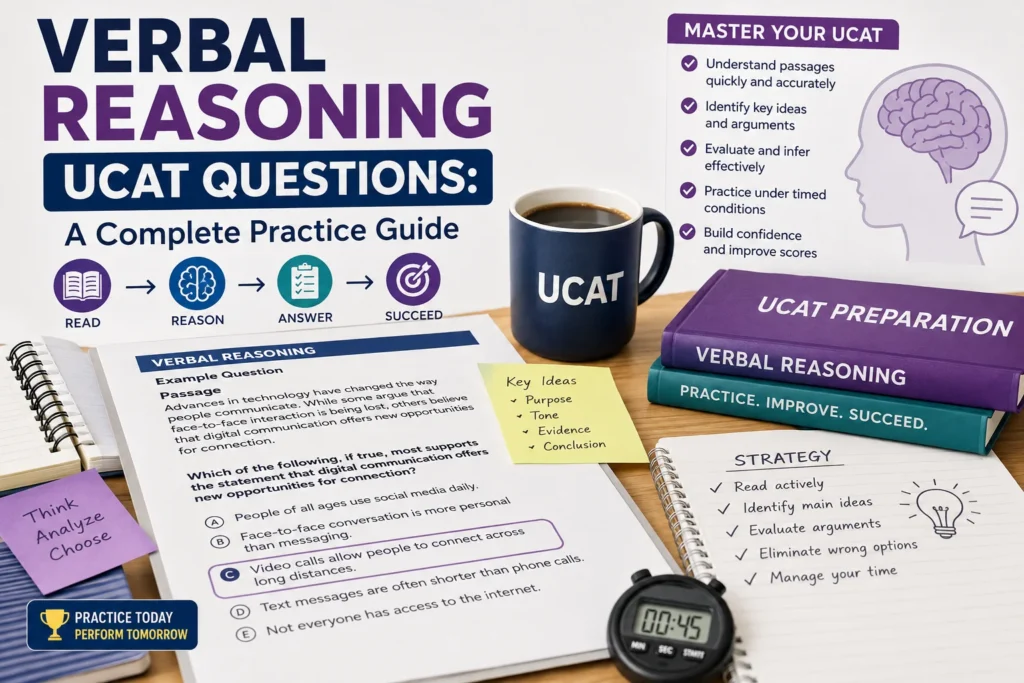
If you’ve looked at a few verbal reasoning UCAT questions already, you’ve probably noticed something: they’re not hard because the passages are complicated. They’re hard because you get roughly 30 seconds a question, and the test is built to punish anyone who reads on autopilot.
That’s the real skill being tested here, not vocabulary, not grammar, just how quickly and accurately you can work out what a passage actually supports. Good news: this is trainable. Most of the students I’ve seen improve their verbal reasoning score did it in a few weeks, not months, once they stopped reading passages the way they’d read a novel and started reading them the way the test wants.
This guide walks through the format, every question type you’ll meet, worked examples, and a timing approach that actually holds up under pressure.
What the Verbal Reasoning Section Actually Tests
Verbal Reasoning is the first of the UCAT’s cognitive subtests. You get 21 minutes to work through 11 short passages, each followed by four questions, 44 questions total. That’s about 28-30 seconds per question, including the time it takes to read.
Here’s the part people miss: it isn’t an English test. You don’t need a big vocabulary, and outside knowledge actively hurts you. If a passage says “some patients,” and an answer option says “most patients,” that’s wrong — even if it happens to be true in real life. Everything has to come from the text in front of you, nothing else.
Passages are usually dry and factual: public health, scientific research, workplace policy, and social issues. Nothing you need prior expertise in.
The Two Question Formats
Every one of the 44 questions falls into one of two formats.
True, False, or Can’t Tell. You’re given a statement and asked whether the passage proves it’s true, proves it’s false, or simply doesn’t give you enough to decide either way. This is the one people get wrong most often, mainly by confusing “plausible” with “provable.” A statement can sound completely reasonable and still be Can’t Tell, because the passage never actually addresses it.
Best-answer multiple choice. You get four options and pick the one the passage best supports. This covers a few recurring styles: main conclusion, author’s opinion, inference, and “which is NOT true” style questions. Since 2013 or so, testing bodies have leaned harder into this format, so it’s worth as much practice time as True/False/Can’t Tell, if not more.
Worked Example: True, False, or Can’t Tell
Here’s a short passage, the kind you’d actually see:
“A recent audit of primary care clinics found that antibiotic prescribing for suspected viral infections dropped by 18% after mandatory prescribing reviews were introduced. The reduction was consistent across most regions, although rural clinics showed smaller improvements than urban ones.”
Statement: “Mandatory prescribing reviews caused a reduction in antibiotic prescribing.”
The instinct is to mark this as True, the numbers back it up, right? But look closer. The passage describes an association: reviews were introduced, and prescribing dropped. It never establishes that the reviews caused the drop. Other things could have changed at the same time. This is a classic dispersion trap, and the correct answer is Can’t Tell.
Statement: “Rural clinics saw a bigger drop in prescribing than urban clinics.”
This one’s more direct. The passage says rural clinics showed smaller improvements than urban ones — the opposite of the statement. That’s a straight contradiction, so the answer is False.
Notice neither answer required outside knowledge about antibiotics or public health policy. Everything you needed was sitting in two sentences.
Worked Example: Best-Answer Question
“Compulsory retirement ages have long been banned in the United States, and the UK should follow suit. Employers who worry about removing older, less effective staff are missing the point; anyone incompetent at their job can be dismissed on merit, not age. Age-based dismissal also opens the door to discrimination claims.”
Which of the following best expresses the author’s main conclusion? A) It’s unfair to keep people working past 65 B) Incompetent employees can be dismissed C) Raising the retirement age would benefit the country D) The UK should abolish compulsory retirement ages
The trap here is that B is technically stated in the passage, but it’s supporting evidence, not the conclusion. C is close but distorts the argument (the passage argues for abolishing the age limit, not raising it). A contradicts the passage outright. The main conclusion, the thing every other sentence is building toward, is D.
This is the pattern worth internalizing: in main-conclusion questions, at least one wrong option will usually be true according to the passage but not the actual conclusion. Don’t just look for a correct statement — look for the one everything else supports.
Question Types You’ll Meet
- Inference questions ask what follows logically from the passage without being stated outright. The line to watch is between “implied” and “assumed”; an inference still has to be backed by the text, not just consistent with it.
- Author opinion and tone questions want the author’s own view, not the views of people or studies the author is quoting. If a passage cites a researcher’s conclusion, that’s not automatically the author’s position.
- Negative questions (using “not,” “except,” or “least”) flip the logic: three options are supported by the passage and one isn’t, and you’re hunting for the unsupported one. Eliminate the three that check out, and you’re left with the answer.
Across every type, three traps keep reappearing: dispersion (true information placed in the wrong context), contradiction (a claim reversed or distorted from the original), and extreme language (absolutes like “always” or “never” that the passage never actually commits to).
A Timing Strategy That Holds Up
Reading strategy matters more than raw speed here. Two approaches work, and which one suits you is genuinely personal:
- Question-first: skim the questions, then scan the passage hunting for the specific sentence that answers each one. Usually faster, since you’re not reading anything you don’t need.
- Passage-first: Read the whole passage once for structure, then answer questions with context already in your head. Often more accurate, but slower.
Try both across a few full-length practice sections and time yourself honestly. Whichever gives you more correct answers within budget is your method — don’t force a technique that isn’t working just because it’s the “recommended” one.
Whatever you choose, set a rough time cap per passage (roughly two minutes) and stick to it. If a question isn’t resolving, flag it, guess, and move on. There’s no penalty for wrong answers in the UCAT, so an unanswered question and a wrong one score exactly the same: zero. Never leave one blank.
Common Mistakes That Cost Marks
- Bringing in outside knowledge. If you happen to know something about the topic, ignore it. The question is only about what the passage says.
- Treating “plausible” as “provable. “Can’t Tell” exists precisely for statements that sound reasonable but aren’t actually backed by the text.
- Getting stuck. Spending three minutes on one question because it feels solvable is the single biggest cause of running out of time. Move on.
- Ignoring absolute language. Words like “always,” “never,” or “all” in an answer option are frequently a sign the option overstates what the passage actually claims.
How to Practise Effectively
Reading about technique only gets you so far; the score comes from reps under real-time pressure. A few things that actually move the needle:
- Take full-length timed practice sections, not just isolated questions, so you build a feel for the two-minutes-per-passage rhythm.
- After each one, review every question you got wrong or guessed on. Look for a pattern. Are you consistently missing Can’t tell questions or struggling with inference?
- Practice skimming and scanning separately using something like newspaper articles so you can extract key facts fast even outside of test-style passages.
- Sit the official practice tests in the real exam interface at least once before test day, since the interface itself takes some getting used to.
FAQ: Verbal Reasoning UCAT Questions
How many verbal reasoning UCAT questions are there? 44 questions across 11 passages, four questions per passage, answered in 21 minutes.
Do verbal reasoning UCAT questions test vocabulary or grammar? No. The section tests reading and reasoning skills, not command of English. Non-native speakers score well on this section regularly.
What’s the difference between False and Can’t Tell? “False” means the passage directly contradicts the statement. Can’t Tell means the passage simply doesn’t give enough information to confirm or deny it, even if the statement sounds reasonable.
Is there negative marking on verbal reasoning UCAT questions? No. Wrong answers and blank answers both score zero, so always select something rather than leaving a question unanswered.
How long do I have per question? About 28-30 seconds on average, though in practice you’ll spend closer to two minutes per whole passage (reading plus four questions).
Should I read the passage first or the questions first? Both work. Question-first is usually faster since you’re scanning for specific answers; passage-first often improves accuracy but costs more time. Test both approaches in practice and use whichever gets you more correct answers.
What’s the best way to improve quickly? Timed full-length practice, reviewed carefully afterward for patterns in your mistakes, tends to produce faster gains than reading strategy guides alone.






1 thought on “Verbal Reasoning UCAT Questions: A Complete Practice Guide”