
What Score Puts You in the MCAT 90th Percentile?
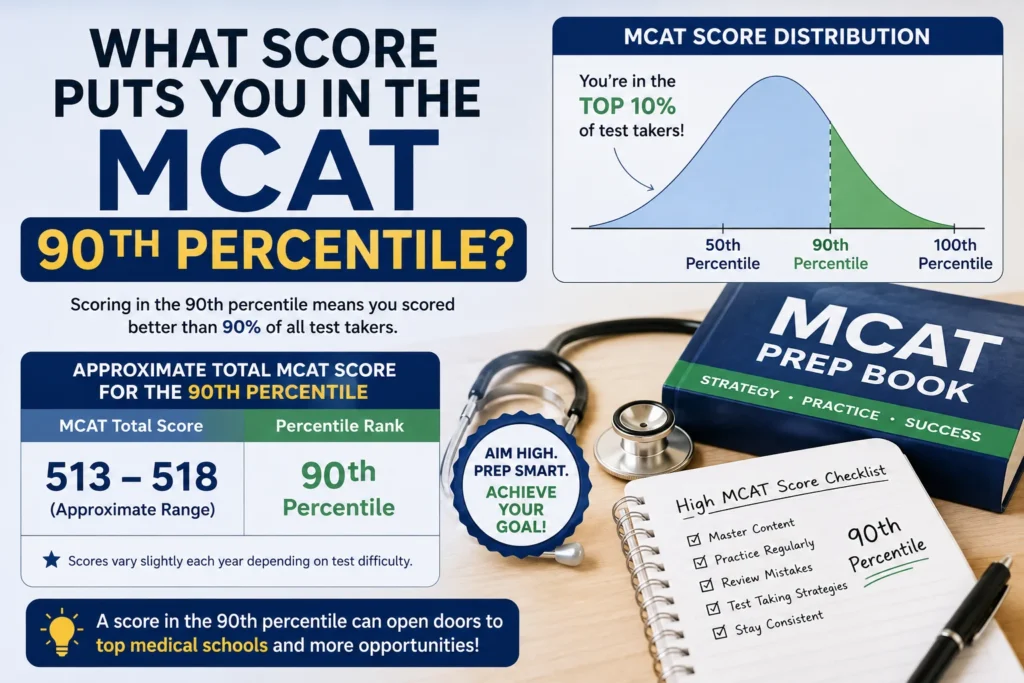
A total MCAT score of 515 lands you in the 90th percentile. That means you outscored roughly nine out of every ten people who sat for the exam. For individual sections, the bar is a little lower: a scaled score of 128 or 129, depending on the section, is usually enough.
That’s the short answer. The longer answer, and the more useful one, is what that number actually means for your application and what it takes to get there.
Quick Reference: Total Score and Section Scores
| Score type | 90th percentile threshold |
|---|---|
| Total score (out of 528) | 515 |
| Chem/Phys (CPBS) | 128 |
| CARS | 128 |
| Bio/Biochem (BBLS) | 129 |
| Psych/Soc (PSBB) | 129 |
These figures come from the AAMC’s percentile ranks currently in effect, based on everyone who tested in 2023, 2024, and 2025. The AAMC updates this table every May 1, so a score that sits at the 90th percentile this year could shift slightly the next.
Worth noting: percentiles aren’t fixed to a single score across all four sections. A 128 happens to be the 90th percentile in CARS but only around the 85th in Chem/Phys because each section has its own distribution of scores. If you want to know exactly where you stand, don’t just eyeball your total. Check your section scores against the current AAMC table.
What “90th Percentile” Actually Means
Percentile rank isn’t the same as percentage correct. Scoring in the 90th percentile doesn’t mean you answered 90% of questions right. It means your scaled score was equal to or higher than 90% of everyone who took the test in the comparison window.
The MCAT is scaled and equated, not curved on the day you sit for it. So a 515 taken in January means the same thing as a 515 taken in September. What changes over time is which raw score maps to which percentile, since the AAMC recalculates that mapping annually using the last three testing years.
How Competitive Is a 515, Really?
Pretty competitive, and here’s some context that makes it concrete. The average total score across all test-takers is around 501. The average score among students who actually enroll in medical school, not just apply, sits closer to 511 or 512, which is roughly the 82nd to 84th percentile. A 515 sits well above that matriculant average.
According to AAMC data cited by Kaplan Test Prep, a score of 514 or higher is associated with roughly a 71% acceptance rate. That’s a meaningful jump from the acceptance rates seen at lower score bands, and it’s a big part of why the 90th percentile gets treated as an informal benchmark for a “strong” applicant.
That said, a 515 doesn’t guarantee admission anywhere, and plenty of applicants get in with lower scores when the rest of their file (GPA, research, clinical hours, essays, interviews) is strong. It’s one input, not the whole equation. If you’re aiming for a top-20 research-focused program, you’ll typically want to be closer to the school’s own matriculant median, which at the most selective programs often runs several points above 515.
Section Scores vs. Total Score: Why Both Matter
You can’t back into a 515 by acing one section and coasting on the others. Each of the four sections is scored from 118 to 132, and your total is just the sum. A lopsided profile, say a 132 in CARS and 126 everywhere else, tells admissions committees a different story than a balanced 129 across the board, even if the totals land close together.
Most committees look at both numbers. A big spread between your best and worst section can raise questions, especially if the weak section is one that’s central to the coursework you’ll face in year one (Chem/Phys and Bio/Biochem tend to draw the most scrutiny here).
What It Actually Takes to Reach 515+
Getting from an average score to the 90th percentile isn’t about grinding through content review for another month. Most students who plateau in the low 500s have already covered the material. What separates a 515 from a 500 usually comes down to a handful of things:
Timed, full-length practice under real conditions. Content knowledge only gets you so far. The MCAT rewards speed and stamina as much as it rewards recall. If you’re not consistently taking full-length practice exams under timed conditions, your score is likely to underperform your actual knowledge on test day.
Reviewing wrong answers for patterns, not just facts. If you miss a question because of a content gap, that’s one kind of error. If you miss it because you misread the question stem or ran out of time, that’s a different problem entirely, and no amount of extra flashcards fixes it. Track why you’re missing questions, not just which ones.
CARS gets its own strategy. This section can’t be crammed the way Bio or Chem can. It rewards daily, deliberate reading practice over months, not weeks. Students who jump ten points in CARS almost always did so through consistent passage practice, not last-minute review.
Diminishing returns on passive review. Rereading content outlines feels productive but tends to plateau quickly. Active recall, practice questions, and full-length exams under test conditions tend to move the needle more once you’re past the initial content-learning phase.
Common Mistakes That Cap Scores Below 90th Percentile
A few patterns show up repeatedly among test-takers who plateau in the 505 to 512 range, just short of 515:
- Treating all four sections equally in study time, instead of weighting the section holding back the total
- Taking full-lengths too infrequently to build real endurance for the seven-and-a-half-hour test day
- Skipping error logs, so the same mistake type keeps repeating across practice tests
- Underestimating CARS, or starting CARS practice too late to see real gains
- Studying content the test doesn’t emphasize heavily, at the expense of high-yield areas
FAQ: MCAT 90th Percentile Questions
Is a 515 a good MCAT score? Yes. It’s above the matriculant average and puts you in the 90th percentile nationally, which is associated with meaningfully higher acceptance rates at most MD programs.
What percentile is a 512 MCAT score? A 512 typically falls around the 83rd to 84th percentile, close to the average score of students who go on to matriculate into medical school.
Do percentile ranks change every year? Yes. The AAMC recalculates percentile ranks each May 1 using the three most recent testing years, so the exact score attached to the 90th percentile can shift slightly from one year to the next.
Is it harder to hit the 90th percentile in one section than another? It can be. Because each section has its own score distribution, the same scaled score doesn’t always land at the same percentile across sections. CARS and Chem/Phys tend to require slightly lower scaled scores to hit the 90th percentile than Bio/Biochem or Psych/Soc.
What score is the 99th percentile? Scores around 523 to 524 and above typically fall in the 99th percentile, though the exact cutoff shifts with each annual update.
Does a 90th percentile MCAT guarantee admission? No. It’s one factor among many, alongside GPA, clinical experience, research, letters of recommendation, and interviews. A strong score improves your odds but doesn’t override a weak overall application.
The Bottom Line
If you’re aiming for the 90th percentile, you’re targeting a 515 total, with section scores in the 128 to 129 range depending on the section. That’s a real, achievable target for students who study consistently, but it typically requires more than content review. Full-length practice under timed conditions, a genuine review process for wrong answers, and dedicated CARS practice tend to be what separates a 500 from a 515.
Check your target schools’ matriculant medians directly, since “good enough” varies a lot depending on where you’re applying. And remember that percentile ranks update every year, so confirm your standing against the current AAMC table rather than an older one you might find floating around online.







1 thought on “What Score Puts You in the MCAT 90th Percentile?”