
Is Exsanex a Scam? What You Need to Know Before Trusting exsanex.com
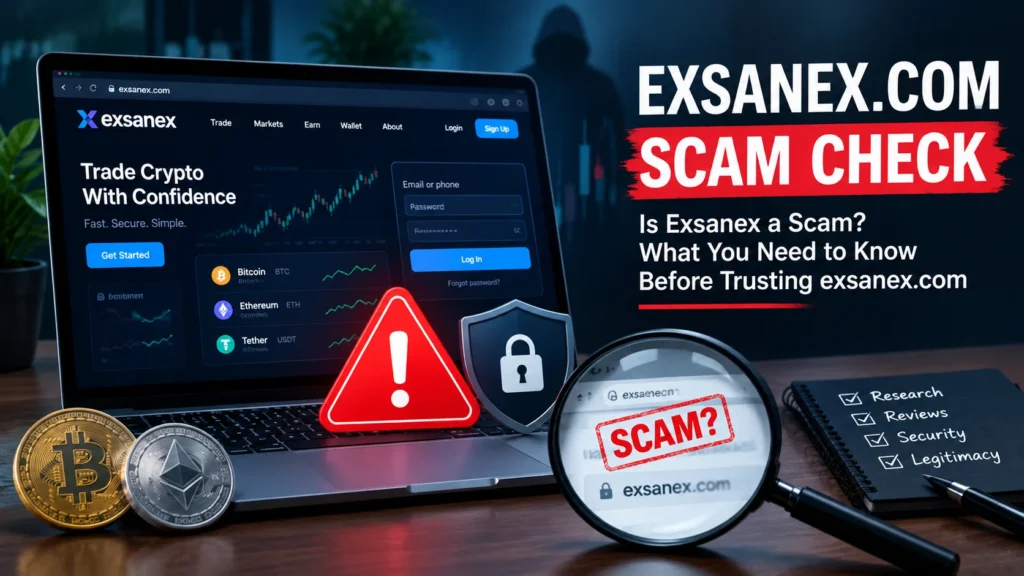
If you’ve landed on this page, you probably saw an ad, a social media post, or a browser pop-up mentioning Exsanex, and something felt off. Good instinct. Multiple independent security researchers and scam-tracking sites have already looked into exsanex.com, and the findings aren’t pretty.
What Is Exsanex?
Exsanex shows up online in two forms, and neither one is good news.
The first is a website, exsanex.com, that presents itself as a cryptocurrency trading and investment platform. The second is a piece of software, sometimes called a browser hijacker or a potentially unwanted program (PUP), that changes your browser settings without clear permission.
Both versions share the same goal: get you to hand over money, personal data, or both.
The Fake Crypto Exchange
Security site MalwareTips examined exsanex.com and concluded it’s a fake crypto exchange. Here’s the pattern researchers found:
- The site claims to run a giveaway “sponsored by Elon Musk,” a name scammers borrow constantly because it lends instant credibility.
- New users are told they’ll receive a balance (often cited around $12,000) just for signing up with a referral code circulating on TikTok, Instagram, and Facebook.
- That balance can never be withdrawn until you first deposit real money, typically around $100.
- Once you deposit, the funds disappear. There’s no real trading engine behind the interface.
Scam Detector ran exsanex.com through its validator and returned a trust score of just 21.4 out of 100, flagging the site as suspicious, unsafe, and doubtful. Their team also noted the site provides almost no verifiable company information: no registration details, no physical address, and no named owners.
ScamDoc’s independent review put exsanex.com’s trust score at a mere 1%, which is about as low as these scores go.
No Way to Verify Who Runs It
A legitimate crypto exchange registers with financial regulators and publishes that information. Exsanex does none of this. There’s no licensing information, no regulatory disclosure, and no working customer support line. The only contact method is typically an automated chat box, which is a common tactic scammers use to avoid leaving a paper trail.
The Browser Hijacker Version
Separately, security researchers at SensorsTechForum have documented Exsanex as a browser hijacker. If this version ends up on your device, usually bundled with free software you downloaded from an untrustworthy source, it can:
- Replace your default search engine without asking
- Redirect new tabs to unfamiliar pages
- Flood your browser with pop-up ads and push notifications
- Slow down your device and, in some cases, open the door to further malware
This is a different threat than the crypto scam, but it uses the same name, which adds to the confusion for anyone trying to research whether Exsanex is safe.
Real People Have Lost Money
This isn’t just a theoretical risk. Reports on platforms like TikTok describe people losing hundreds of dollars after depositing funds into Exsanex, expecting to withdraw a promised bonus that never materialized. One widely shared account describes a $500 loss. Scam-tracking site Scamwatcher also lists Exsanex as a suspected investment scam based on user reports.
Red Flags That Apply to Exsanex (and Similar Sites)
If you’re trying to size up whether any crypto platform is trustworthy, these are the signals that gave Exsanex away:
- A celebrity “sponsorship” you can’t verify. Elon Musk has never partnered with Exsanex. Scammers invoke his name because it’s recognizable and hard for most people to fact-check quickly.
- A deposit required to unlock “free” money. Legitimate giveaways don’t ask you to pay first.
- No regulatory registration. Real exchanges are licensed somewhere and will tell you where.
- No verifiable company details. No address, no named executives, no business registration number.
- Pressure through referral codes and urgency. Scammers rely on social proof and time pressure to short-circuit careful thinking.
What to Do If You’ve Interacted With Exsanex
- Stop sending money immediately. Don’t deposit more in an attempt to “unlock” a withdrawal; that’s a common follow-up tactic.
- Contact your bank or card issuer. If you paid by card, ask about a chargeback. If you sent crypto, recovery is much harder, but report it anyway.
- Change your passwords, especially if you reused one on the Exsanex site.
- Run a malware scan if you suspect the browser hijacker version affected your device, and reset your browser’s default search engine and homepage.
- Report it. File a report with the FTC at reportfraud. ftc.gov (U.S.) or your country’s equivalent consumer protection agency, and consider leaving a report on sites like Scamwatcher so others are warned.