What Is Urban Dictionary? How the Slang Site Actually Works
If you’ve ever texted a friend and gotten back a word you didn’t recognize, there’s a good chance you ended up on Urban Dictionary trying to decode it. The site has become the internet’s go-to source for slang, but most people who use it daily have no idea how it’s built or who runs it.
The Short Answer
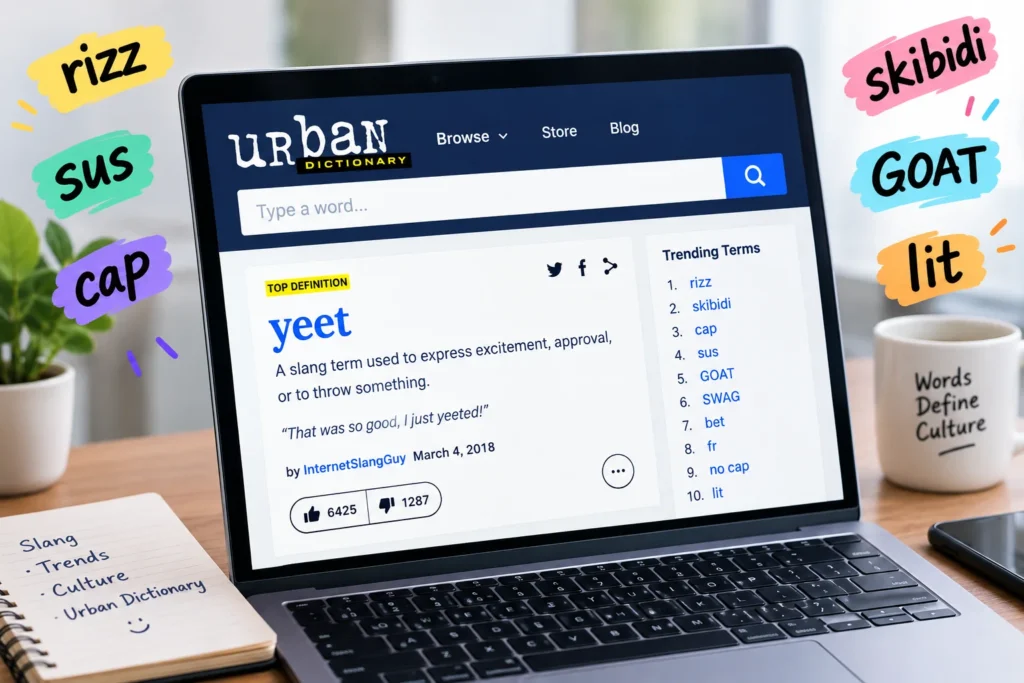
Urban Dictionary is a crowdsourced, user-written dictionary for slang, internet culture, and informal language. Instead of a team of professional lexicographers deciding what makes the cut, anyone can submit a definition, and readers vote entries up or down. The highest-voted definition for a word rises to the top of its entry.
Who Started It, and Why?
Urban Dictionary launched on December 9, 1999, created by Aaron Peckham, who was a freshman computer science major at California Polytechnic State University, San Luis Obispo, at the time. His original goal was smaller than what the site became: he wanted a way to compare the slang used by students in different parts of California. What started as a class-project-sized idea turned into a global reference for internet English, and Peckham still runs it today.
The name itself is a bit of a joke. It was built as a parody of traditional dictionaries, poking fun at the stiff, formal tone of print references by embracing whatever language people were actually using on the street.
How Definitions Actually Get Published
The process is simpler than most people assume:
- Someone submits a word and definition. Anyone with an account can write one, along with an example sentence and optional tags.
- The community moderates it. Volunteer editors review new submissions and approve or reject them before they go live.
- Readers vote. Once published, every definition gets thumbs-up and thumbs-down votes from site visitors.
- The best (or funniest) definition wins the top spot. A word can have dozens of competing definitions; the one with the strongest net votes appears first when you search it.
This structure is why the same word can have wildly different meanings depending on who wrote the top-ranked entry. It’s less a dictionary in the traditional sense and more a running public vote on what language means right now.
Why It’s Not Always Reliable
Because entries are written and voted on by the general public, quality varies enormously. Some definitions are genuinely useful references for slang, regional dialect, or internet culture. Others are jokes, inside references, or, at times, offensive content that slipped past moderation. It’s worth treating Urban Dictionary the way you’d treat any user-generated platform: useful for a quick gut check on what a term means, but not a substitute for a vetted, professionally edited source when accuracy really matters.
Bigger Than a Novelty Site
Despite its informal roots, Urban Dictionary has ended up in some surprisingly formal places. Definitions from the site have been cited in court opinions when judges needed to understand slang used in testimony or evidence, referenced by linguists studying how language changes, and covered by major outlets like CNN and Time. Peckham has also published print compilations of top entries, turning the crowdsourced site into physical dictionary books.