Vercept’s Vy AI Agent: What It Did and Why It’s Gone
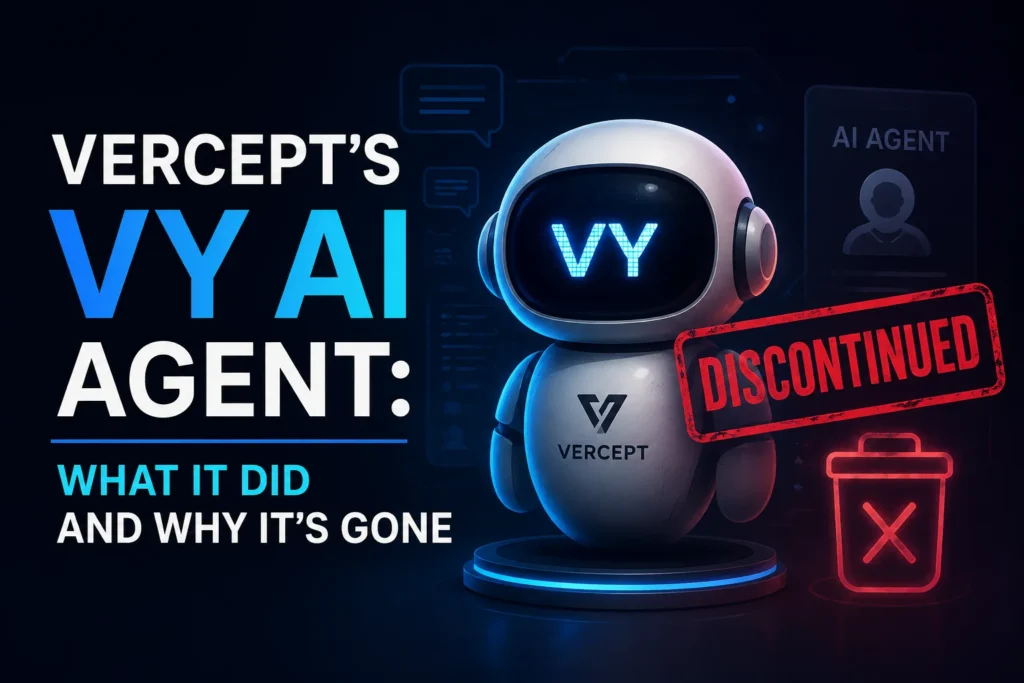
If you searched “Vercept Vy” hoping to download the app, here’s the short version: you’re a few months too late. Vercept, the Seattle startup behind Vy, was acquired by Anthropic in February 2026, and the standalone product was wound down within 30 days of the deal. The technology didn’t disappear, though. It moved.
Here’s what Vy actually was, why Anthropic wanted it, and where to go if you’re looking for something that does the same job today.
[Hero image prompt: Split visual of a laptop screen with a cursor mid-click on a desktop app interface, soft blue and white color palette, minimalist tech illustration style, clean lines, professional and modern mood, 1200x600px, white background]
What Was Vercept, and What Did Vy Do?
Vercept was founded in November 2024 by Matt Deitke, Kiana Ehsani, Luca Weihs, and Ross Girshick, a team with roots at the Allen Institute for AI. The company’s bet was that most AI tools were still stuck typing text at people, when what users actually wanted was software that could just do the tasks on their behalf.
Their product, Vy, was a Mac-native (later cross-platform) agent that watched your screen, moved your cursor, clicked buttons, and typed into fields, the same way a person would. Instead of relying on developer APIs or scraping a webpage’s underlying code, Vy took what the founders called a vision-first approach: it captured screenshots, ran them through a computer-vision model to identify buttons and menus, then translated a plain-language instruction into mouse and keyboard actions.
That distinction mattered. Tools like UiPath depend on brittle selectors that break the moment an interface changes. API-first automators like Zapier only work where a vendor has built an integration. Vy worked with whatever was on screen, which meant it could operate inside apps that had never been designed for automation at all.
Real users put it to work on things like reconciling data between two SaaS tools that didn’t talk to each other, batch-organizing files, prepping video-editing timelines, and cleaning up CRM records. One standout feature was “watch and repeat”: show Vy a task once, and it could reproduce it later without you writing a script.
Why Anthropic Bought Vercept
On February 25, 2026, Anthropic announced it had acquired Vercept and would bring the team into its Claude engineering organization. In Anthropic’s own announcement, the company framed the deal around a specific problem: making AI genuinely useful for complex work requires solving perception and interaction challenges that text-only models can’t handle on their own.
That framing lines up with where Anthropic had already been headed. Claude had previewed computer-use capabilities, controlling a virtual desktop and completing structured workflows, before this acquisition ever happened. Vercept’s screenshot-based, vision-first architecture was a faster path to making that reliable across real, messy desktop environments rather than a sandboxed demo.
Vercept wasn’t Anthropic’s only acquisition around that period; the company had also brought on the team behind Bun shortly before. The pattern suggests Anthropic is assembling in-house infrastructure for agentic computer use rather than building it from scratch or licensing it.
What Happened to the Standalone Vy App
This is the part most people searching this keyword actually want to know: no, Vy is not available as a separate product anymore. Per the acquisition terms, the standalone app was sunset within 30 days of the February 2026 announcement, and its underlying technology is being folded into Claude’s computer-use feature set instead of continuing as an independent tool.
So while “Vercept AI” and “Vy” still show up in search results, treat any listing that suggests you can currently download and run the old Mac app with real skepticism. Reviews and comparison sites written before mid-2026 will describe a product that, as of this writing, no longer exists in its original form.
Early user feedback on Vy was generally positive on the core idea, less so on execution polish. One recurring theme in reviews: the vision-first approach genuinely understood on-screen content better than DOM-scraping competitors, but the agent could be slow to think and click, and it occasionally made incorrect assumptions about what a user wanted, which was frustrating mid-task. Other users flagged more specific friction: mis-clicks on dense interfaces, trouble with fast-changing modal dialogs, and losing track of state across multiple hidden windows.
What to Use Instead of Vy Today
If you were interested in Vy specifically because you wanted an AI agent to operate your own computer, you have two reasonable paths.
If you’re already a Claude user, the most direct continuation of Vy’s approach now lives inside Claude’s computer-use tools, since that’s literally where the Vercept team and technology went. Anthropic’s Claude Cowork product, aimed at non-developer, multi-step agentic work, is the closest analog to what Vy tried to do on a Mac desktop.
If you want a standalone desktop agent from another vendor, the current field includes a mix of managed and self-hosted options, each with different tradeoffs:
- Manus – a fully managed, general-purpose cloud agent good for research and multi-step tasks, though it offers more limited desktop automation than Vy did.
- Sai (Similar) – runs in a secure cloud workspace with no local setup and asks for approval before critical actions.
- OpenClaw – open source, with the most local control, but it requires real technical setup and credential management.
- Perplexity Computer – strong for research-heavy workflows that lean on real-time web synthesis.
None of these are a one-to-one replacement for Vy’s specific vision-first, no-API-integration approach to desktop automation. That was arguably Vy’s most distinctive trait, and it’s the piece that’s now embedded inside Claude rather than shipping as an independent app.
The Bigger Trend This Points To
Vy’s short life as a standalone product says something about where this category is heading. Small, technically strong teams building agentic computer-use tools are getting absorbed into the major AI labs rather than growing into independent companies. Manus reportedly followed a similar path with Meta in early 2026. For users, that means the specific tools you evaluate this year may not exist as separate products next year, even if the underlying capability keeps improving somewhere else.
If you’re choosing a computer-use agent today, it’s worth weighing not just what the tool does now but also which company is behind it and how likely that team is to get folded into a bigger platform within the next twelve months.