What Is StafferLink? Healthcare Workforce Software Explained
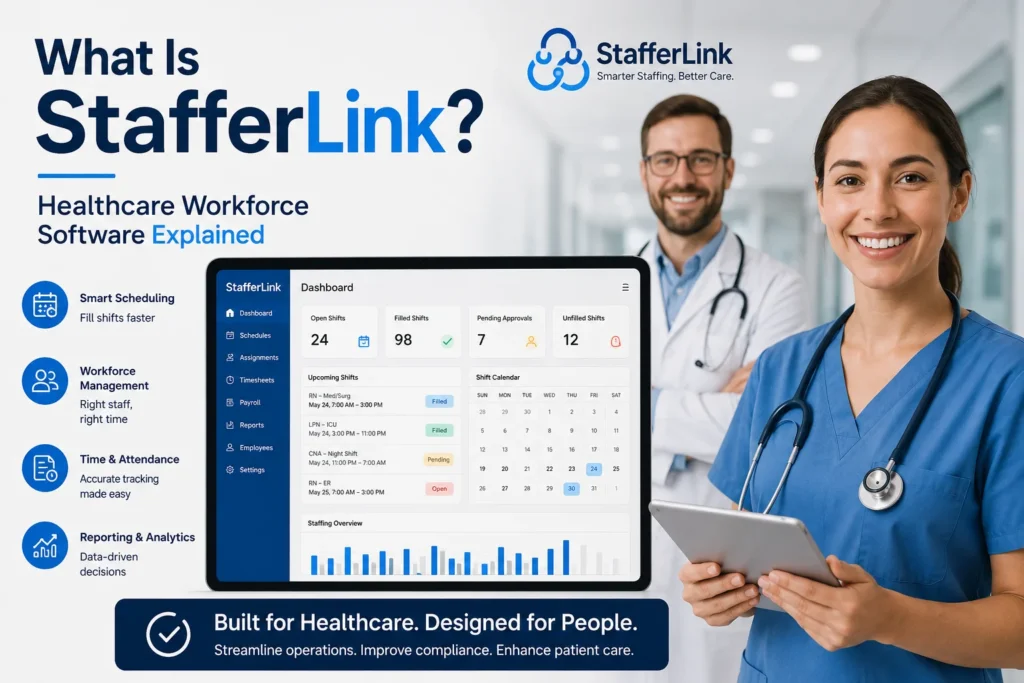
If you work in healthcare staffing, on either the facility side or the agency side, you’ve probably run into StafferLink at some point. It’s not a household name outside the industry, but inside it, the platform has quietly become one of the go-to systems for managing contingent (non-employee) healthcare workers.
Here’s what it actually is, how it works, and where it fits if you’re comparing workforce software.
StafferLink, in Plain Terms
StafferLink is a cloud-based software company that builds tools for managing the healthcare “gig” workforce, meaning per diem staff, travel nurses, and agency-supplied workers who aren’t full-time employees. It was founded in 1995 in Fayetteville and has spent three decades focused specifically on healthcare, rather than trying to serve every industry at once.
That healthcare-only focus shows up in the details. Generic workforce platforms often bolt on compliance and credentialing as an afterthought. StafferLink built its systems around those requirements from the start, which matters a lot in an industry where a single expired license or missing certification can shut down a shift.
In April 2025, StafferLink was acquired by Smartlinx, a workforce management company focused on senior care organizations. According to StafferLink’s own leadership, the two companies served adjacent but non-overlapping parts of the market, so the deal was framed as filling a gap rather than consolidating competitors. Existing StafferLink customers weren’t required to switch platforms as part of the acquisition.
The Two Core Products
StafferLink’s software splits into two main platforms, depending on who’s using it.
StafferLinkVMS (for facilities and MSPs)
This is a vendor management system built for hospitals, healthcare facilities, and managed service providers (MSPs) that work with multiple staffing agencies at once. Instead of juggling separate relationships and paperwork with each agency, a facility runs everything through one system.
Key capabilities include:
- Order management that lets a facility configure and automate open-shift requests across multiple locations, down to the individual shift level
- Registry tools for populating, validating, and reviewing worker credentials before a shift is confirmed
- Consolidated billing, so rates, hours, and costs from many agencies land in one invoice instead of dozens
StafferLinkASM (for staffing agencies)
This side of the platform is aimed at the agencies themselves. ASM stands for Agency Staffing Management, and it covers the agency’s internal workflow: recruiting, onboarding, credentialing, and paying its own pool of workers.
Notable features include an applicant tracking system built specifically for healthcare hiring, a self-service portal where candidates can upload and update their own credentials, and payroll tools that support multiple payment methods. Agencies can also use ASM on its own, without needing a client facility to already be on StafferLink, and doing so gives them visibility into shift opportunities across the broader network.
Why Credentialing Is the Centerpiece
Ask anyone who’s worked in healthcare staffing what actually eats up their time, and credentialing usually tops the list. Licenses, certifications, background checks, and required training all have expiration dates, and tracking them manually across hundreds or thousands of workers is a losing battle.
StafferLink’s platform reportedly manages tens of millions of individual credentials across its client base, with real-time tracking and expiration alerts built into both the VMS and ASM products. That’s less a nice-to-have feature and more the actual reason a lot of agencies and facilities adopt the software in the first place.
Scale and Who Uses It
StafferLink works with more than 2,000 healthcare staffing agencies, and its platform is reportedly used to fill upwards of two million shifts a year while processing over a billion dollars in staffing spend. Customers span facility types, though the company has traditionally had a strong presence in long-term and post-acute care, which lines up with why Smartlinx, a senior-care-focused company, saw the acquisition as a fit.
The client base skews toward organizations juggling a mix of internal staff and outside agency workers rather than facilities that rely entirely on one or the other.
How It Compares to Other Healthcare Workforce Tools
StafferLink isn’t the only option in this space. Newer entrants like SourceNow have launched AI-driven VMS platforms with real-time shift matching, and broader staffing software providers such as BlueSky Medical Staffing Software and IntelyCare compete for similar customers, especially in nursing and per diem placement.
The main differentiator for StafferLink is its history and specialization. Thirty years in one vertical means the platform has been shaped almost entirely by healthcare compliance rules, rather than adapted from a general-purpose staffing tool. Whether that history matters more than a newer, AI-forward competitor’s feature set depends on what a given facility or agency actually needs, whether that’s proven reliability at scale or the latest matching technology.
Getting Started with StafferLink
StafferLink doesn’t publish pricing publicly. Like most enterprise workforce software, it works on a custom-quote model, so facilities and agencies typically go through a demo and needs assessment before getting a rate. If you’re evaluating it, it’s worth having your credentialing requirements, current agency count, and shift volume ready, since those details shape what implementation actually looks like.