
Dichotomous Questionnaire Example: Templates and Tips
Hero image prompt: Two survey response cards side by side on a light desk surface, one labeled “Yes” in blue, one labeled “No” in gray, a pen resting between them, soft natural window light, minimalist flat lay, neutral color palette, professional photography, 1200x600px, shallow depth of field.
If you’ve ever answered “yes” or “no” on a form and moved on without a second thought, you’ve taken a dichotomous question. It’s the simplest question format in survey design, and it’s also one of the most misused. Ask the wrong one and you’ll get clean data that tells you almost nothing.
This guide walks through what a dichotomous questionnaire actually is, gives you real examples across different industries, and covers when this format helps (and when it quietly wrecks your results).
What Is a Dichotomous Question?
A dichotomous question offers exactly two mutually exclusive answers. No middle ground, no “somewhat,” no five-point scale hiding in the background. Common formats include:
- Yes / No
- True / False
- Agree / Disagree
- Male / Female (for demographic screening, where applicable)
- Pass / Fail
The word comes from “dichotomy,” meaning a division into two parts. According to the SAGE Encyclopedia of Communication Research Methods, this format fits best when the topic under study genuinely has two natural values, though almost any variable can be forced into two categories if a researcher wants it that way. That last part is the catch: forcing a nuanced opinion into a binary box is where a lot of surveys go wrong, and we’ll get to that.
Dichotomous Questionnaire Examples by Use Case
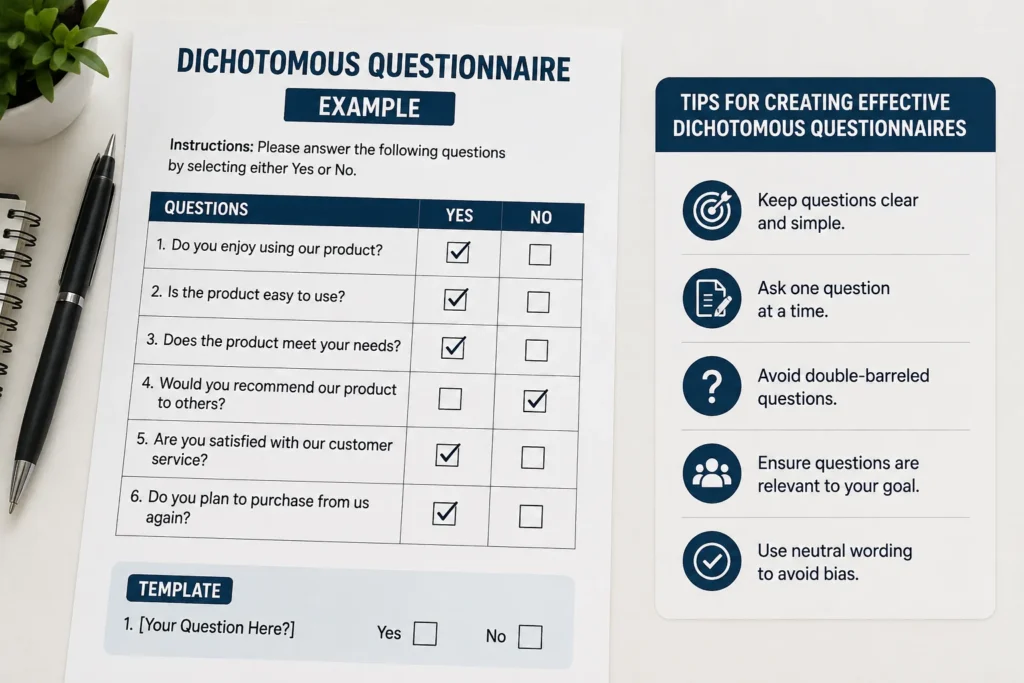
Here’s how the format shows up across different fields. Notice the pattern: each question is factual, screening-based, or a hard yes/no decision point, not an opinion that deserves nuance.
Customer Feedback
- Have you purchased from us before? (Yes / No)
- Did you receive your order on time? (Yes / No)
- Would you recommend us to a friend? (Yes / No)
HR and Employee Engagement
- Do you feel your manager communicates expectations clearly? (Yes / No)
- Have you completed the required compliance training? (Yes / No)
- Are you currently considering leaving the company? (Yes / No)
Health and Medical Intake
- Are you currently pregnant? (Yes / No)
- Have you ever been diagnosed with diabetes? (Yes / No)
- Are you currently taking prescription medication? (Yes / No)
Education and Testing
- The mitochondria is the powerhouse of the cell. (True / False)
- Did the student submit the assignment on time? (Yes / No)
Market Research and Screening
- Do you own a smartphone? (Yes / No)
- Have you heard of this brand before today? (Yes / No)
Body image prompt: A simple two-column comparison chart titled “Dichotomous vs. Likert Question,” left column showing a Yes/No toggle icon, right column showing a five-point scale icon, flat vector design, blue and orange color scheme, white background, clean sans-serif labels, 1000x500px.
When Dichotomous Questions Work Well
They’re not a lazy shortcut. Used correctly, they solve a specific problem: getting a fast, unambiguous answer from someone who doesn’t want to think hard about your survey.
They work best for:
- Screening questions. “Are you over 18?” doesn’t need five options.
- Eligibility checks. Compliance and intake forms rely on clean binary answers.
- High-volume surveys. When you’re sending a form to 10,000 people, every extra second of thought hurts your completion rate.
- Filtering logic. A “yes” or “no” answer can branch a respondent into different follow-up questions.
When to Avoid Them
Here’s the honest downside nobody puts on the marketing page: dichotomous questions throw away information. If someone is 90% satisfied and you only give them “Satisfied” or “Not Satisfied,” you lose that nuance permanently. You can’t recover it in analysis later.
Skip the binary format when:
- The topic genuinely has shades of opinion (use a Likert scale instead)
- You need to measure intensity or frequency, not just presence or absence
- Respondents might reasonably answer “it depends.”
A quick gut check before you write one: would a reasonable person ever want to answer “sometimes” or “not sure”? If yes, don’t force it into “yes”/”no.”
How to Write a Good Dichotomous Question
A few rules that separate a clean binary question from a confusing one:
- Keep it factual, not evaluative. “Did you attend the event?” beats “Was the event good?” every time.
- Avoid double-barreled questions. “Did you find our staff friendly and helpful?” forces two judgments into one answer. Split it.
- Watch for leading language. “Don’t you agree our support team is excellent?” isn’t a neutral question anymore.
- Make the options genuinely exhaustive. If “N/A” or “unsure” is a realistic answer, your two options aren’t covering the full range of responses, and your data will quietly lie to you.
- Test it on someone outside your team. They’ll spot ambiguity you’ve gone blind to.
FAQ: Dichotomous Questionnaire Questions
Q: What’s the difference between a dichotomous question and a Likert scale question? A: A dichotomous question has exactly two answer options, while a Likert scale offers a range, usually 5 or 7 points, to capture degree or intensity of opinion.
Q: Can a dichotomous question have more than two options? A: No. The moment you add a third option, it becomes a multiple-choice or nominal question instead, not a dichotomous one.
Q: Are Yes/No and True/False the same thing? A: They’re both dichotomous formats, but Yes/No usually captures a fact or decision, while True/False typically tests knowledge or a stated claim.
Q: Why do researchers use dichotomous questions in health surveys? A: Many health conditions genuinely are binary (diagnosed or not, pregnant or not), so a dichotomous format captures the real answer without adding false complexity.
Q: Do dichotomous questions hurt survey accuracy? A: Only when they’re used for topics that actually have a range of possible answers. Used for genuinely binary facts, they’re one of the more reliable question types available.
Q: What’s a good sample size for a dichotomous survey? A: It depends on your confidence level and margin of error, but because binary answers are easy to analyze statistically, dichotomous surveys often need fewer responses than open-ended formats to reach a valid conclusion.
Bottom Line
A dichotomous questionnaire is the right tool when you want speed, clarity, and a question that genuinely has two answers. It’s the wrong tool; the moment you’re trying to squeeze an opinion into a box it doesn’t fit. Look at your question, ask whether “it depends” is a fair answer, and let that decide the format for you.







1 thought on “Dichotomous Questionnaire Example: Templates and Tips”