
What Are Survey Questionnaires? A Complete Guide for Businesses
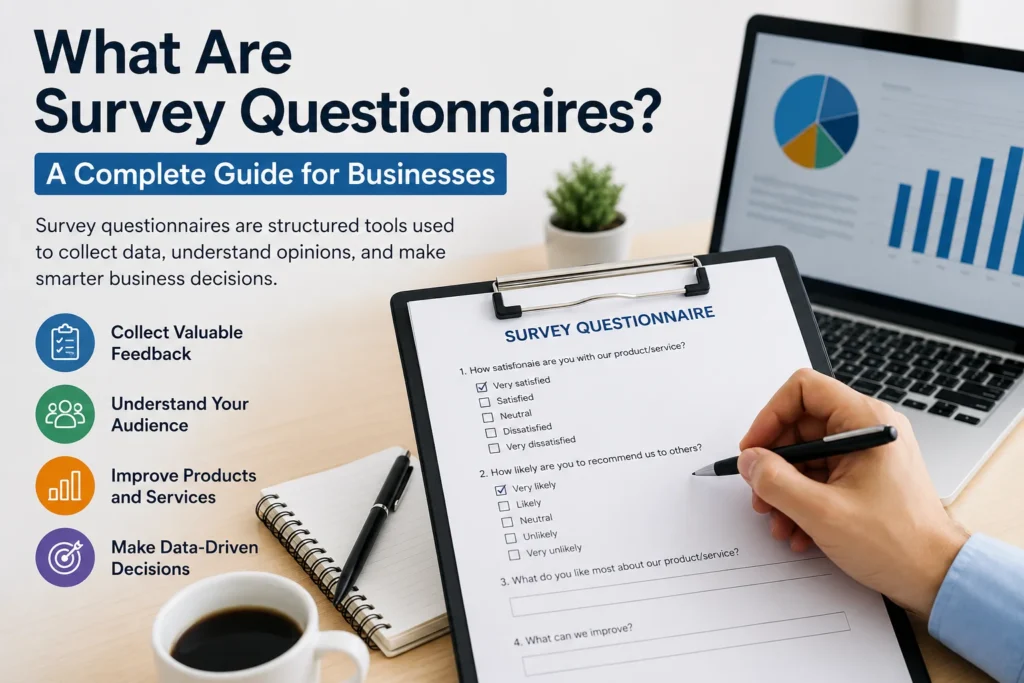
If you’ve ever filled out a customer satisfaction rating, an employee engagement check-in, or a “how did we do?” email after a purchase, you’ve used a survey questionnaire. They’re everywhere, and for good reason: they’re one of the cheapest, fastest ways for a business to find out what people actually think.
But “questionnaire” and “survey” get used interchangeably so often that the distinction gets lost. Here’s the short version: a questionnaire is the set of questions. A survey is the whole process, questionnaire included, plus the sampling, distribution, and analysis around it. You can’t run a survey without a questionnaire, but a questionnaire can technically exist without becoming part of a formal survey.
That difference matters more than it sounds like it should, because it affects how you design one, who you send it to, and what you can actually do with the results.
What Is a Survey Questionnaire?
A survey questionnaire is a structured set of questions designed to collect information from a group of people, usually to measure opinions, behaviors, or experiences in a way that can be compared across respondents. Every person sees the same questions in the same order. That consistency is the whole point. It’s what lets you take hundreds or thousands of individual answers and turn them into a chart, a trend line, or a decision.
They show up constantly in business settings:
- Customer satisfaction (CSAT) and Net Promoter Score (NPS) surveys
- Employee engagement and exit interviews
- Market research before a product launch
- Post-event or post-purchase feedback
- Academic and healthcare research studies
The format hasn’t changed much in decades. What has changed is delivery. Most questionnaires now go out by email, embedded web link, or in-app pop-up rather than paper or phone, which is part of why response rates and design standards have shifted so much over the last ten years.
The Three Main Types of Questionnaires
Not every questionnaire is built the same way, and the type you choose depends entirely on what kind of answer you’re after.
Structured Questionnaires
These use fixed questions with fixed answer options, like multiple choice, rating scales, or yes/no. Every respondent answers the exact same way, which makes the data easy to count, graph, and compare. A CSAT survey asking someone to rate their experience from 1 to 5 is a textbook structured questionnaire. If you need numbers you can act on quickly, this is usually the right call.
Unstructured Questionnaires
Here, questions are open-ended: “What could we do better?” or “What made you choose us over a competitor?” There’s no predefined list of answers. This gets you richer, more honest detail, but it takes longer to read and requires someone to actually interpret the responses rather than just tallying them. Exit interviews often lean unstructured for this reason.
Semi-Structured Questionnaires
Most business questionnaires actually fall here, a mix of closed questions for hard numbers and a few open fields for context. You get a satisfaction score you can track over time, plus a comment box that tells you why the score is what it is. It’s more work to analyze than a purely structured form, but it’s usually worth it.
Common Question Formats
Within any of those three types, individual questions can take several shapes:
- Multiple choice — pick one or several from a list
- Likert scale — rate agreement or satisfaction on a numbered scale
- Rating scale — score something from, say, 1 to 10
- Dichotomous — simple yes/no or true/false
- Open-ended — free text response
- Ranking — order a set of options by preference
- Demographic — age, location, income bracket, and similar background details
Mixing formats within a single questionnaire tends to keep people engaged longer than a wall of identical rating-scale questions does. It also gives you different kinds of data to work with once the responses come in.
Why Businesses Rely on Questionnaires
The appeal comes down to cost and speed. According to research summarized by SimplyPsychology, online questionnaires now give researchers cheap, fast access to large and geographically diverse samples compared to older methods like phone or in-person interviews. You can send a questionnaire to 5,000 people and have usable data back within a week, something that would have taken months with door-to-door interviews.
There’s a consistency benefit too. Because every respondent answers the same questions in the same order, you’re comparing apples to apples. That’s what makes it possible to say something like “satisfaction dropped 8% this quarter” with any confidence, rather than just gut-checking a handful of anecdotes.
None of that makes questionnaires perfect, though. Self-reported data has real limits: people answer how they’d like to be seen, not always how they actually feel, and long surveys see drop-off rates climb fast. A well-designed questionnaire manages those risks; it doesn’t eliminate them entirely.
Questionnaire Design: What Actually Trips People Up
A handful of mistakes show up in weak questionnaires again and again.
Leading questions. Asking “How much did you love our new feature?” pushes people toward a positive answer before they’ve even thought about it. Neutral phrasing gets you honest data.
Double-barreled questions. “Was our support fast and helpful?” is really two questions jammed into one. If support was fast but rude, there’s no accurate way to answer.
Too many open-ended fields. Free text feels more thorough, but stack five of them in a row and completion rates fall off a cliff. Save open questions for the one or two things you actually need detail on.
Vague scales. A rating from 1 to 5 without labels on each number leaves too much open to interpretation. Label at least the endpoints, and ideally every point on the scale.
Skipping a pilot test. Sending a questionnaire to 2,000 people without testing it on 10 first is how you find out, too late, that question 7 doesn’t make sense to half your audience.
Questionnaire vs. Survey: The Short Answer
Since this trips people up constantly, here’s the distinction stated plainly: the questionnaire is the instrument, the specific questions, and their order. The survey is the entire research effort built around it, including who you sample, how you distribute it, and how you analyze what comes back. You could hand someone a questionnaire on the street and get one filled-out form. Run that same questionnaire through a proper sampling plan and analysis, and now you’ve run a survey.
The Bottom Line
A survey questionnaire is simply a consistent set of questions used to gather comparable information from a group of people, and the type you pick, structured, unstructured, or semi-structured, should follow directly from what you’re trying to learn. Get the format and the question design right, and a questionnaire becomes one of the most reliable ways a business has to replace guesswork with actual data.









1 thought on “What Are Survey Questionnaires? A Complete Guide for Businesses”