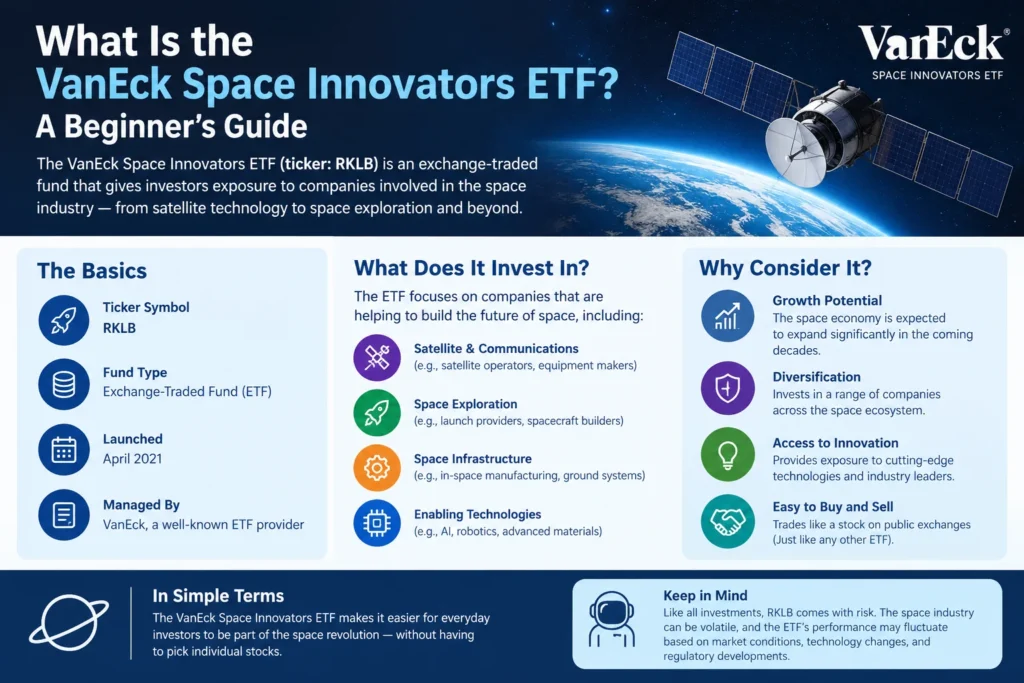
What Is the VanEck Space Innovators ETF? A Beginner’s Guide
Space stocks make great headlines and rough price charts. If you like the theme but don’t want to bet on one rocket company, a fund spreads that risk around. This guide covers what the VanEck Space Innovators ETF holds, what it costs, and where it can hurt you.
What is the VanEck Space Innovators ETF?
The fund trades as JEDI. It follows the share prices of companies building the commercial space age, with exposure to satellite equipment, communications, exploration, and space travel and tourism. It also aims to hold companies that could earn about half their revenue from space-related work. It launched in June 2022.
Its benchmark is the MarketVector Global Space Industry Screened Index, which follows the largest and most liquid companies in the global space industry. It’s a passive fund, so no manager is picking winners.
What’s inside the fund?
JEDI holds 25 companies, and the top ten made up 63.21% of assets on 31 August 2026. That’s concentrated. A few names drive most of the results.
It’s also global. As of April 2026, the biggest country weights were the USA, Japan, and Taiwan, and the top holdings included Planet Labs and Viasat. Holdings shift often, so check VanEck’s site for the current list before you buy.
How much does it cost?
The total expense ratio is 0.55% a year. On a 5,000 investment, that’s 27.50 a year in fees. Broad index funds often charge far less, so you’re paying extra for the narrow theme. Whether that’s fair depends on how much you believe in it.
Size matters too. The fund held about €2.33 billion in assets in June 2026, which is plenty of room to trade without trouble.
What are the risks?
Honestly, they’re not small. VanEck lists equity market risk, sector concentration risk, and the risk of investing in smaller companies. In plain terms, the whole fund can fall together because it’s all one theme, and small companies swing hard.
Valuation is worth a look as well. The fund’s price-to-earnings ratio was 37.64 at the end of August 2026. That’s pricey next to many broad funds, which means investors already expect a lot of growth.
Spacing out your purchases over several months can soften the bumps. It won’t remove the risk, though.
Who might consider it?
It fits someone who already holds a broad fund and wants a small slice of a growth theme. It doesn’t suit money you’ll need within a few years. A sensible rule is keeping a theme fund like this to a modest share of your portfolio.
Where you live changes things. JEDI is a UCITS fund, listed on exchanges including London, Deutsche Börse, SIX Swiss and Borsa Italiana. Some brokers outside Europe don’t offer UCITS funds to retail investors, so check yours first