
Back Muscles: A Beginner’s Guide to Anatomy and Strength
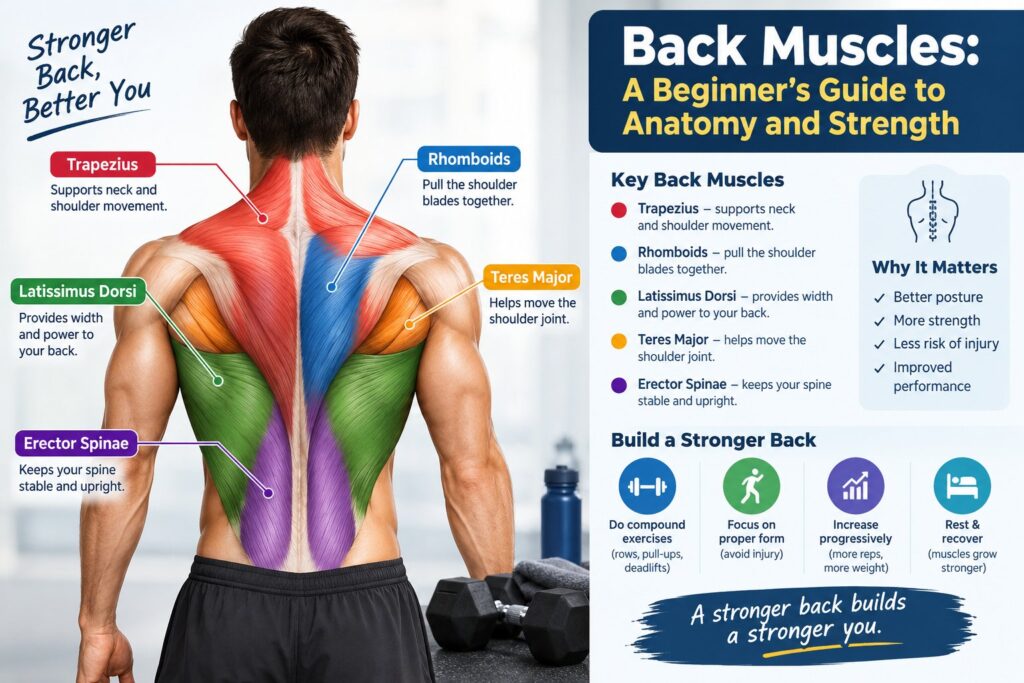
Ask ten gym-goers to point to their back muscles, and most will wave vaguely at the area behind their shoulder blades. Fair enough. The back is a huge region, and the muscles there do far more than build a V-shaped torso. They hold you upright at your desk, let you twist to grab a seatbelt, and even help you breathe. Here’s what they are, how they’re organized, what they do, and how to train them without wrecking your spine.
What Are Back Muscles?
Your back muscles form a layered network stretching from just under the skull to the top of the hips. They attach to the vertebrae and ribs, and they act as the main structural support for your trunk, keeping posture steady whether you’re moving or sitting still.
That constant workload has a price. Muscles in this area are among the most commonly injured in the body, and problems with them are a leading cause of low back pain. Worth remembering before you try a heavy deadlift on a cold morning.
The Three Layers of Back Muscles
Anatomists sort the muscles of the back into three groups. Deep (intrinsic) muscles fuse with the spinal column, superficial muscles assist the shoulders and neck, and intermediate muscles help move the rib cage. Some references go further and say only the deep group counts as true back muscles. Nobody at the gym cares about that distinction, though. If it sits on your back, you’ll end up training it.
Superficial Layer
These are the ones you can see in the mirror. The trapezius is a diamond-shaped sheet running from the base of the skull to the mid-back, and it lifts, retracts, and lowers the shoulder blades. The latissimus dorsi, or lats, is the broad wing along your sides that pulls the arm down and back. Underneath the trapezius, the rhomboids squeeze the shoulder blades together, while the levator scapulae raises them.
Intermediate Layer
Two thin muscles, the serratus posterior superior and inferior, assist the ribs during breathing. Almost nobody trains them directly. Honestly, you don’t need to.
Deep Layer
The erector spinae is a set of three columns (iliocostalis, longissimus, and spinalis) running along both sides of the spine. They straighten your back and stop it from folding forward. Below them sit smaller stabilizers such as the multifidus, which links one vertebra to the next and fine-tunes spinal position. Many trainers and physios point to weak stabilizers as one contributor to nagging stiffness, though pain has plenty of causes.
What Do Back Muscles Actually Do?
Four jobs, mostly.
- Support: They keep your trunk stacked and stable against gravity.
- Movement: They let you bend, twist, turn your head, and extend your spine.
- Limb control: They help move the head, neck, shoulders, arms, and legs.
- Breathing: They help the chest expand and contract with each breath, an automatic action you never have to think about.
So a strong back isn’t only about aesthetics. It’s what makes lifting a suitcase, carrying a toddler, or sitting through a long meeting feel easy instead of punishing.
Best Exercises for Strong Back Muscles
You don’t need a fancy gym. Cover these five movement patterns and you’ve hit nearly every layer:
- Lat pulldown or pull-up: targets the lats.
- Bent-over or seated row: works the rhomboids, middle trapezius, and lats.
- Face pull: hits the upper and middle trapezius and rear shoulders.
- Back extension or Romanian deadlift: trains the erector spinae.
- Bird dog: builds the small stabilizers along the spine.
For most beginners, two sessions per week with 2 to 3 sets of 8 to 12 controlled reps is a sensible start. Begin lighter than your ego wants. Form beats weight every time.
Yanking the weight. Momentum swaps muscle work for joint stress. Slow down.
Rounding the lower back under load. A neutral spine matters most during deadlifts and rows.
Training only the mirror muscles. Heavy chest work with little rowing pulls the shoulders forward over time.
Skipping the warm-up. A few light sets of the same movement take two minutes.
Ramping up too fast. Cleveland Clinic advises raising activity levels gradually rather than suddenly jumping up your training intensity.
When Back Pain Means See a Professional
Mild soreness after a workout is normal. Pain that lingers, sharpens, or follows an injury isn’t. Cleveland Clinic recommends seeing a healthcare provider if you have back pain or suspect you’ve hurt your back. Get checked quickly if you notice numbness, leg weakness, fever alongside back pain, or any change in bladder or bowel control. This article is educational, not medical advice.