
Membrane Bound Organelles: The Cell’s Walled-Off Workshops
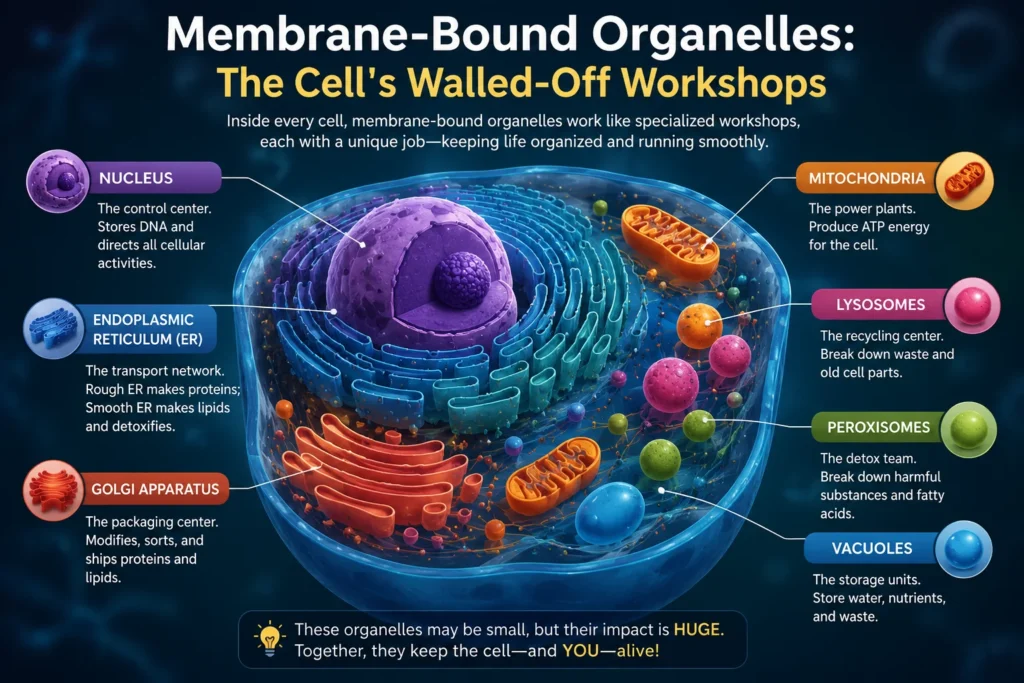
Picture your body’s cells as tiny cities. Some buildings need walls to keep their work contained, whether that’s a power plant generating energy or a chemical factory processing waste. That’s essentially what membrane-bound organelles are: specialized structures inside a cell, each wrapped in its own membrane, doing a specific job without interference from everything else going on around it.
What Makes an Organelle “Membrane Bound”
Every cell is packed with structures called organelles, but not all of them have a membrane. Ribosomes, for example, build proteins but have no membrane at all. Membrane bound organelles are different: they’re enclosed by a lipid bilayer, the same kind of fatty, water-repelling layer that forms the cell’s outer wall. This barrier lets the organelle keep its internal environment, its chemicals, and its enzymes separate from the rest of the cell.
Why does that separation matter? Because a lot of the chemical reactions happening inside a cell would clash if they occurred in the same open space. Digestive enzymes that break down waste, for instance, would be disastrous if they leaked freely into the cell’s main fluid. The membrane keeps everything organized, like walls between departments in a busy office.
Only eukaryotic cells (the kind found in animals, plants, fungi, and protists) have these compartments. Bacteria and other prokaryotes lack them, which is one of the biggest structural differences between the two types of life.
The Main Membrane-Bound Organelles and What They Do
The nucleus is the most familiar one. It houses a cell’s DNA behind a double membrane called the nuclear envelope, protecting genetic material and controlling which instructions get passed out to the rest of the cell.
Mitochondria are often called the cell’s power plants, and for good reason. They convert nutrients into ATP, the energy currency cells run on. Interestingly, mitochondria have their own small set of DNA, separate from the DNA in the nucleus, which is one of the clues scientists use to trace how this organelle may have originated from ancient free-living bacteria.
The endoplasmic reticulum (ER) comes in two types. The rough ER, studded with ribosomes, builds and folds proteins. The smooth ER, without ribosomes, handles lipid production and detoxification.
The Golgi apparatus works like a shipping department. It receives proteins and lipids from the ER, modifies them further, and packages them for delivery to wherever they’re needed, inside or outside the cell.
Lysosomes act as the cell’s recycling and cleanup crew. Packed with digestive enzymes, they break down waste, worn-out organelles, and invading pathogens.
Chloroplasts, found in plant and algae cells, capture sunlight and convert it into chemical energy through photosynthesis. Like mitochondria, chloroplasts carry their own DNA, supporting the theory that both organelles descended from bacteria engulfed by an early ancestor cell.
Vacuoles vary in size and job depending on the organism. In plant cells, one large central vacuole often takes up most of the cell’s volume, storing water, nutrients, and waste while helping maintain the cell’s rigidity.
Why This Compartmentalization Matters
Splitting a cell into specialized, membrane-enclosed sections lets it run several different chemical processes at once without them interfering with each other. A cell can build proteins, generate energy, and break down waste simultaneously because each task happens in its own contained space, with its own chemical conditions tailored to that job.
This organization also makes cells more efficient. Enzymes and reactants stay concentrated where they’re needed instead of getting diluted throughout the entire cell, which speeds up reactions and reduces wasted resources.
Membrane Bound vs. Non-Membrane-Bound Organelles
It’s worth drawing a clear line between the two categories. Non-membrane-bound structures, like ribosomes and the cytoskeleton, still perform essential functions but don’t have that protective lipid layer isolating them. Membrane bound organelles, by contrast, are self-contained units, almost like cells within a cell, each with a distinct internal environment suited to its role.
A Quick Comparison
| Organelle | Main Function | Found In |
|---|---|---|
| Nucleus | Stores and protects DNA | Nearly all eukaryotic cells |
| Mitochondria | Produces energy (ATP) | Animal and plant cells |
| Endoplasmic Reticulum | Builds proteins and lipids | Animal and plant cells |
| Golgi Apparatus | Modifies and ships proteins | Animal and plant cells |
| Lysosomes | Breaks down waste | Mostly animal cells |
| Chloroplasts | Photosynthesis | Plant and algae cells |
| Vacuoles | Storage, structure | Especially prominent in plant cells |
The Bottom Line
Membrane bound organelles are what give complex cells their remarkable efficiency. By walling off specific jobs into their own compartments, a single cell can juggle energy production, waste disposal, protein building, and genetic storage all at the same time, without one process getting in the way of another. It’s a system of organized chaos that, remarkably, keeps every living eukaryotic cell running smoothly.







1 thought on “Membrane Bound Organelles: The Cell’s Walled-Off Workshops”