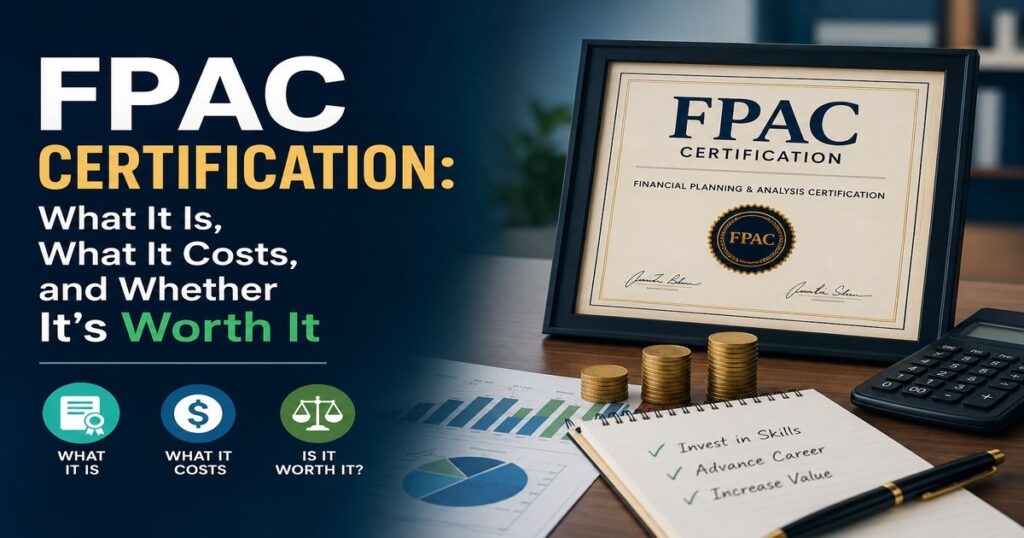
FPAC Certification: What It Is, What It Costs, and Whether It’s Worth It
If you work in financial planning and analysis, you’ve probably heard FP&A managers mention the FPAC credential in the same breath as the CPA or CFA. It’s not as widely known outside finance circles, but inside FP&A, it carries real weight.
FPAC stands for Certified Corporate Financial Planning & Analysis Professional. It’s issued by the Association for Financial Professionals (AFP), the same organization behind the Certified Treasury Professional (CTP) designation. Where CTP focuses on treasury and cash management, FPAC is built specifically for people who forecast, budget, model, and report on business performance.
What the FPAC Actually Tests
The FPAC exam is a two-part, computer-based test made up of multiple-choice and spreadsheet-based questions. Part I has 140 questions and Part II has 55, and together they run up to 180 minutes for the first part and 270 minutes for the second. You sit for each part separately, and you don’t need to pass both in the same testing window.
The content itself covers forecasting, budgeting, financial modeling, variance analysis, reporting, and business partnering, essentially the day-to-day toolkit of a working FP&A analyst or manager. That’s a deliberate design choice: AFP built the exam around what practitioners actually do, not abstract accounting theory.
Who Qualifies to Sit for the Exam
You can’t just show up and register. AFP generally requires a bachelor’s degree (or equivalent) plus two to three years of full-time FP&A experience, with the exact experience requirement depending on your educational background. If you already hold a CMA, CPA, CTP, or CFA, some of that experience requirement can be waived.
Once you’re accepted into the program, the clock starts running. You have five years from enrollment to complete every requirement, and if you don’t finish in that window, any part you’ve already passed expires, and you’ll need to reapply and retake both parts.
What It Costs
Pricing depends on your membership status and how early you register. Based on 2026 published rates:
- AFP members: roughly $1,025 (early deadline) to $1,125 (standard deadline)
- Non-members: roughly $1,420 to $1,520
- Corporate practitioners (a special eligibility category): as low as $1,195 for Part I and $895 for Part II
That’s the exam fee alone. Most candidates also buy AFP’s Exam Prep Platform, which isn’t required but is widely recommended, especially for the spreadsheet-based questions that trip people up.
Once you’re certified, it’s not a one-and-done fee either. The annual recertification cost is $85 for members and $200 for non-members, and you’ll need to log continuing education credits to stay current.
How Long It Takes and When You Can Test
Testing only happens in two windows a year: February–March and August–September. Because of that, most people build their study plan around a six-to-twelve-month runway. One FPAC holder who also works as an exam-prep instructor put it plainly: he studied 50 to 60 hours and, in hindsight, wished he’d spent more time, particularly using the official prep platform, which he described as something he wouldn’t have passed without.
That timeline matters for planning. If you miss a registration window, you’re waiting several months for the next one, not scheduling on demand like some other professional exams.
Is FPAC Worth It?
This is really the question people are searching for, so here’s the honest answer: it depends on where you are in your career.
AFP states that FPAC-certified professionals earn about 8% more than uncertified peers, though that figure varies by role, location, and company size, so treat it as a general signal rather than a guarantee. Separately, nearly 90% of FPAC holders report the certification has been valuable to their career, and manager- and director-level holders earn roughly 5% more in base salary than uncertified peers, according to AFP’s own compensation survey.
The credential also has genuine scarcity value. AFP welcomed just 178 new FPAC holders in 2025, and the community, while growing internationally, is still small compared to credentials like the CPA. For analysts and managers trying to differentiate themselves for a senior analyst, FP&A manager, or business-partner role, that scarcity plus AFP’s reputation is exactly what makes the letters mean something on a resume.
Where it matters less: if you’re already a director, VP, or CFO, the marginal career benefit shrinks. At that level, your track record does more talking than a credential, and one FPAC reviewer who’s held the certification for years put it this way: the certification isn’t necessary to thrive in FP&A or reach the CFO seat, and the further along you get in your career, the less lift it provides.