
What Is a Smartwatch? A Complete Beginner’s Guide
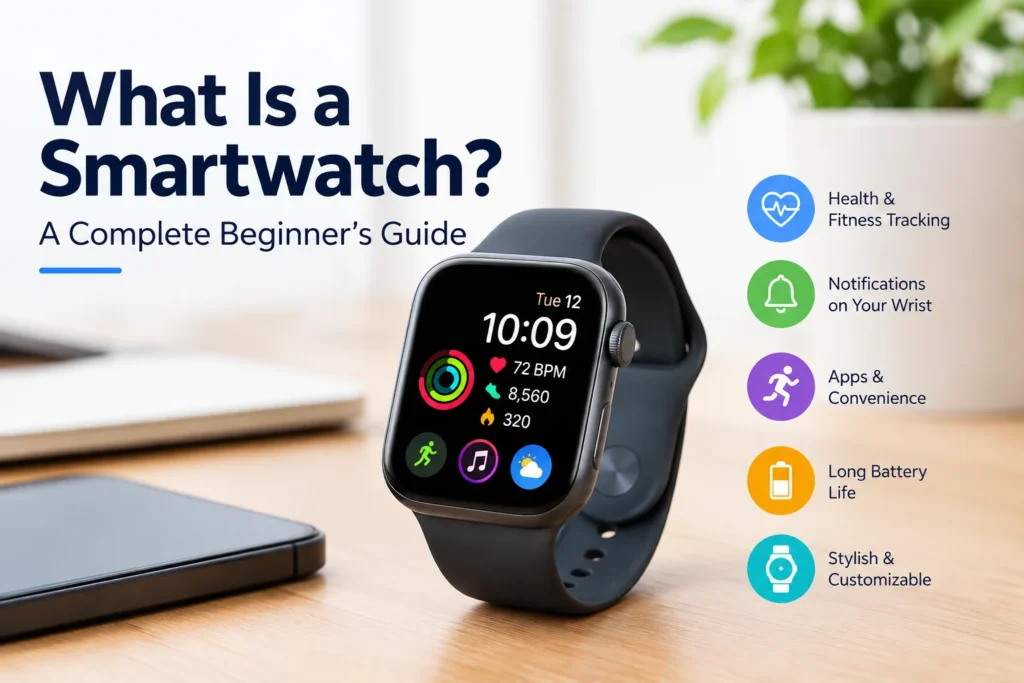
A smartwatch is a wrist-worn computer. It looks like a regular watch, but underneath that dial sits a small processor, a battery, sensors, and wireless radios that connect it to your phone and the internet. Instead of just telling time, it can track your heart rate, answer texts, play music, guide you on a run, and in some cases even make phone calls, all from your wrist.
If you’ve ever wondered whether a smartwatch is worth the hype, or you’re just trying to understand what one actually does before you buy your first, this guide breaks it down in plain language.
The Short Answer
At its core, a smartwatch is a miniature computer you wear like a watch. It runs an operating system (usually a lightweight one built for small screens and long battery life), connects to your smartphone over Bluetooth or Wi-Fi, and runs apps. Some models can even work independently with their own cellular connection, so you can leave your phone at home and still get calls and messages.
The category includes everything from fitness-first devices like the Garmin Forerunner to all-purpose devices like the Apple Watch and Samsung Galaxy Watch, which blend notifications, health tracking, payments, and third-party apps into one device.
How a Smartwatch Actually Works
A smartwatch pairs with your phone through a companion app. Once connected, it can pull in notifications, calendar events, and messages and push data the other way, like your step count or sleep history, into health apps on your phone.
Inside the case, you’ll typically find:
- A small display: Usually OLED or LCD, often touch-sensitive
- Sensors: Heart rate monitors, accelerometers, gyroscopes, and, on many newer models, blood oxygen (SpO2) sensors and even ECG capability
- A battery: Ranging from about 18 hours (Apple Watch) to several weeks (many Garmin and fitness-focused models)
- Wireless radios: Bluetooth at minimum, often Wi-Fi, and sometimes LTE for standalone cellular use
- A processor and storage: Enough to run apps, store music, and process sensor data on the device itself
What Can You Actually Do With One?
Most people buy a smartwatch for a handful of core reasons. Here’s what that actually looks like day to day.
Health and fitness tracking. This is the biggest draw for most buyers. A smartwatch can log your steps, distance, heart rate, sleep stages, and workouts automatically. Higher-end models add blood oxygen readings, stress tracking, and, on select devices, ECG readings that can flag irregular heart rhythms.
Notifications on your wrist. Texts, calls, calendar alerts, and app notifications show up without you touching your phone. This is genuinely one of the most-used features, since checking your wrist is faster and less socially disruptive than pulling out a phone.
Contactless payments. Apple Pay, Google Pay, Samsung Pay, and similar systems let you tap your watch at a checkout terminal instead of carrying a wallet.
Voice assistants. Siri, Google Assistant, or Bixby, depending on the platform, let you set timers, send messages, or check the weather by voice.
Music and audio control. You can control playback from your phone, or on some models, store music directly and stream to Bluetooth headphones without a phone nearby.
GPS and navigation. Built-in GPS lets runners and cyclists track routes and pace without needing a phone along for the ride.
Smartwatch vs. Fitness Tracker: What’s the Difference?
People often mix these up, and the line has blurred over the years, but there’s still a meaningful distinction.
A fitness tracker, like a basic Fitbit or Xiaomi Mi Band, is built primarily around health and activity data. It’s usually smaller, lighter, cheaper, and has a much longer battery life, but it runs few or no third-party apps and has limited notification support.
A smartwatch is a general-purpose device. It runs a full app store, supports deep phone integration, and often includes payments and cellular options, in addition to fitness tracking. You’re paying more and charging more often in exchange for far more functionality.
If your main goal is counting steps and tracking sleep, a fitness tracker is usually the better value. If you want a phone-adjacent device on your wrist, a smartwatch makes more sense.
The Main Smartwatch Platforms
- Apple Watch (watchOS): Tightly integrated with iPhone, strongest app ecosystem, iPhone-only
- Samsung Galaxy Watch (Wear OS): Works with Android generally, with the deepest integration with Samsung phones specifically
- Google Pixel Watch (Wear OS) — Android-focused, close ties to Google services
- Garmin (Garmin OS): Built for serious athletes and outdoor use, exceptional battery life, less focused on general apps
- Fitbit: Now under Google, it sits between fitness tracker and smartwatch depending on the model
Your phone’s operating system usually narrows the choice quickly. iPhone owners are effectively limited to Apple Watch for full functionality, while Android owners have more brand flexibility.
Do You Actually Need One?
Not everyone does. If you rarely check notifications, don’t care about workout data, and are happy with a traditional watch, a smartwatch may just be another gadget to charge every night.
But if you find yourself constantly pulling out your phone for quick checks, want a nudge toward more consistent exercise, or you’re managing a health condition where heart rate or sleep data is useful, the value becomes obvious fairly quickly. Many people who resist buying one end up wondering, a few months in, how they managed without it.