Best Productivity Tools for Small Teams in 2026
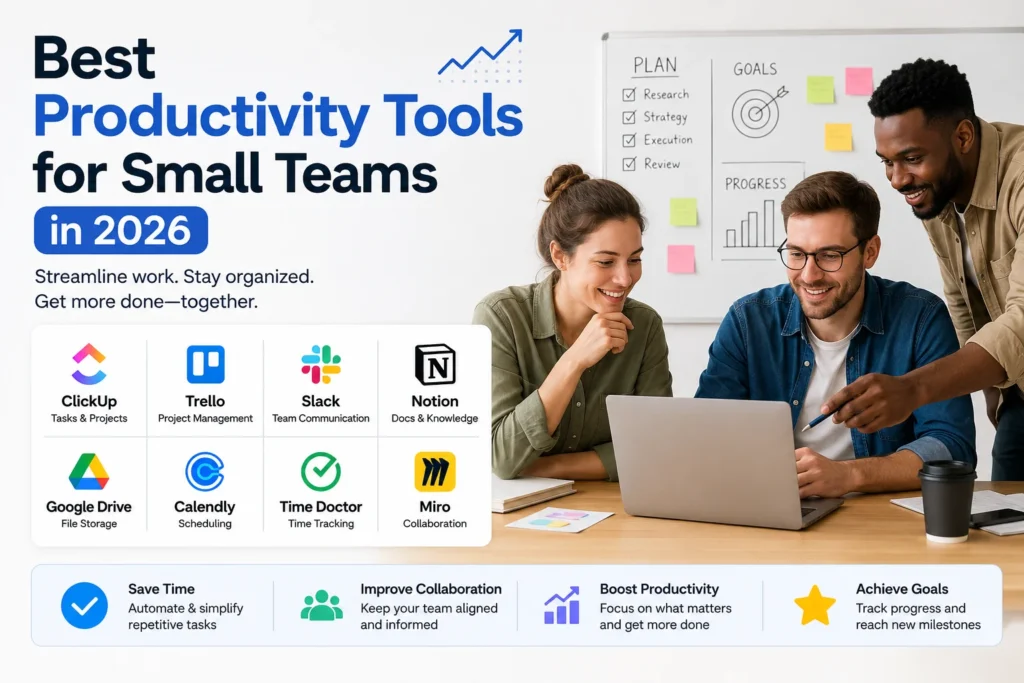
A team of six doesn’t need what a team of six hundred needs. Most “best productivity tools” lists don’t make that distinction, so small teams end up comparing pricing tiers and feature checklists built for enterprises they’ll never resemble. This guide narrows the field to tools that actually fit a small team: a handful of people, a modest budget, and no dedicated IT department to manage the rollout.
What Small Teams Actually Need From a Productivity Tool
Before comparing options, it helps to know what separates a good fit from a bad one at a small-team scale.
- A usable free or low-cost tier. Most platforms cap free plans at 10-15 members, which covers plenty of small teams outright.
- Fast setup. If onboarding takes a week, the tool is fighting the very productivity it’s meant to create.
- One system, not five. Consolidating tasks, files, and communication into fewer tools cuts the coordination overhead that eats into actual work time.
- Room to grow. A tool that gets abandoned at 20 employees means migrating data twice, which is worse than just picking well the first time.
With that in mind, here’s how the leading options stack up.
Best Productivity Tools for Small Teams: Quick Comparison
| Tool | Best For | Free Plan | Starting Paid Price |
|---|---|---|---|
| Asana | Task and project tracking | Up to 15 members | ~$10.99/user/month |
| Trello | Simple Kanban boards | Unlimited boards, limited automation | ~$6/user/month |
| Notion | Docs, notes, and light project tracking | Generous free tier for small teams | ~$10/user/month |
| Motion | AI-driven scheduling and task planning | No free plan | ~$19-34/user/month |
| Slack | Team communication | Limited message history | ~$8.75/user/month |
| Teamwork.com | Client work with budgets and time tracking | Up to 15 members | ~$10.99/user/month |
1. Asana — Best All-Around Task Manager
Asana organizes work into tasks, projects, and timelines without the visual clutter some competitors pile on. It suits small teams that want structure without a steep learning curve.
Why it works for small teams: the free plan covers up to 15 members with unlimited tasks and projects, which is often enough for an entire early-stage team. Paid tiers add timeline views and reporting once the team outgrows spreadsheets.
Where it falls short: deeper automation and portfolio-level reporting sit behind the higher-priced plans, so cost climbs fast once a team needs those features.
2. Trello — Best for Visual, Low-Friction Task Tracking
Trello’s card-and-board format is close to self-explanatory. New hires can start using it the same day, with no training session required.
Why it works for small teams: it’s the lightest option on this list. For teams that just need to see who’s doing what, Trello does the job without extra setup.
Where it falls short: as task volume grows, boards get messy fast. Teams that need dependencies, budgets, or detailed reporting outgrow it quickly.
3. Notion — Best for Notes, Docs, and Project Tracking in One Place
Notion blends a notebook, a wiki, and a lightweight project tracker into one connected workspace. Small, knowledge-heavy teams (agencies, startups, content teams) tend to get the most out of it.
Why it works for small teams: one tool replaces a notebook app, a task list, and an internal wiki, which is a meaningful cost and cognitive-load reduction for a small headcount.
Where it falls short: it isn’t built for resource scheduling, time tracking, or financial reporting. Teams delivering client work with budgets to track usually need something more specialized.
4. Motion — Best for AI-Driven Scheduling
Motion automatically slots tasks into calendar time based on deadlines and priority, rebuilding the schedule whenever something changes.
Why it works for small teams: it removes the manual replanning that eats into a founder’s or manager’s day when priorities shift, which happens often on small teams wearing multiple hats.
Where it falls short: there’s no free plan, and the price per user is higher than most alternatives on this list, so it’s a harder sell for very early-stage or budget-constrained teams.
5. Slack — Best for Team Communication
Slack remains the default choice for small-team messaging, replacing scattered email threads with searchable channels.
Why it works for small teams: it connects to nearly every other tool on this list, so notifications and updates surface in one place instead of five inboxes.
Where it falls short: free plans cap message history, which becomes a real limitation once a team wants to search back through older decisions.
6. Teamwork.com — Best for Small Teams Doing Client Work
Teamwork.com bundles project management with built-in time tracking and budget visibility, aimed squarely at agencies and consultancies rather than internal-only teams.
Why it works for small teams: the free plan supports up to 15 members with unlimited tasks and projects, and time tracking is native rather than bolted on, which matters for teams billing clients by the hour.
Where it falls short: if a team doesn’t bill clients or track project profitability, this level of detail is more than needed. Simpler tools do the core job for less.
How to Choose the Right Tool for Your Team
Match the tool to the actual bottleneck, not the longest feature list.
- If coordination is the problem: start with Asana or Trello.
- If information is scattered across docs and chats: Notion consolidates it.
- If your team bills clients and needs to track profitability: Teamwork.com is built for that specifically.
- If your calendar never matches your task list: Motion solves that gap directly.
- If communication itself is the bottleneck: Slack, paired with whichever task tool you pick.
Most small teams end up running two tools well rather than one tool for everything: a task/project tracker plus a communication tool. Trying to force a single platform to do both often means compromising on both.
FAQ: Productivity Tools for Small Teams
Q: What’s the best free productivity tool for a small team? A: Asana and Teamwork.com both offer free plans supporting up to 15 team members with unlimited tasks and projects, which covers most small teams without paying anything.
Q: How many tools should a small team actually use? A: Most small teams do best with two: one for tasks and projects, one for communication. Adding more tools usually adds coordination overhead rather than reducing it.
Q: Is Notion a good replacement for a dedicated project management tool? A: For light project tracking alongside docs and notes, yes. For teams managing budgets, time tracking, or complex dependencies, a dedicated tool like Asana or Teamwork.com fits better.
Q: Do small teams need AI scheduling tools like Motion? A: Only if manual replanning is a real time drain. Teams with stable, predictable workloads often don’t need it; teams juggling constantly shifting priorities get more value from it.
Q: What should a small team prioritize when comparing productivity tools? A: Fast setup, a usable free tier, and how well the tool integrates with what the team already uses. Feature-for-feature comparisons matter less than fit for the team’s actual workflow.