
What Eric Schmidt Really Said About China’s Tech Work Hours
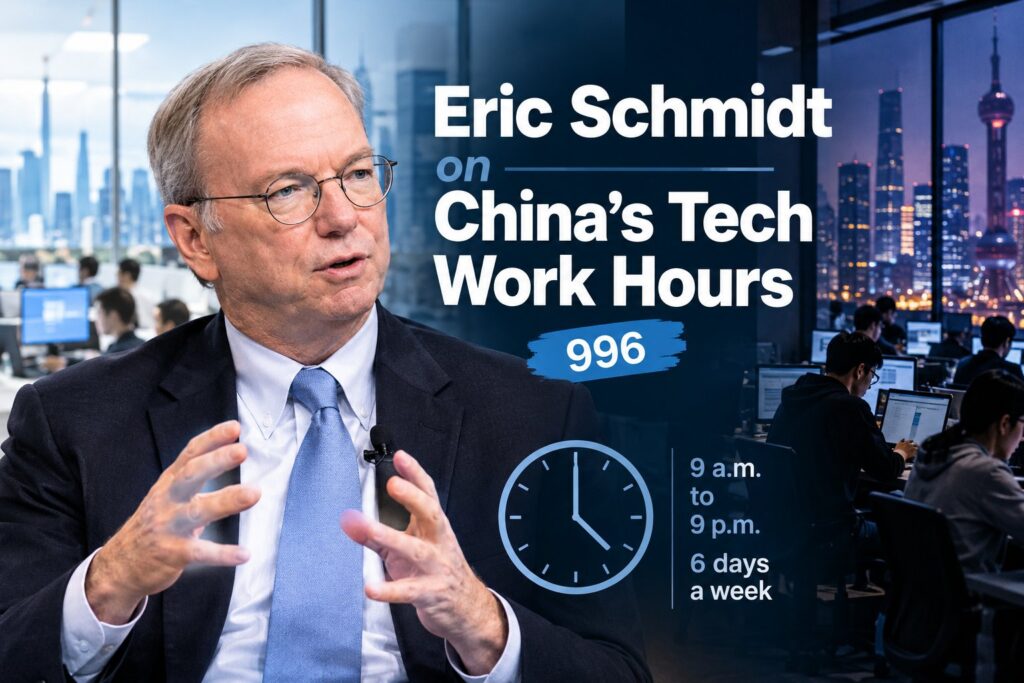
One interview clip set off a week of arguing about China’s tech work hours. In a conference interview published by the All-In podcast in September 2025, Eric Schmidt said winning in tech means accepting tradeoffs. The former Google CEO pointed to China’s 9 a.m. to 9 p.m. schedule as the standard to beat. Several headlines said he wanted Americans to copy it. That’s not quite what he said. Here’s the record, the numbers behind it, and where the claim gets shaky.
What did Eric Schmidt say about China’s tech work hours?
Schmidt said anyone who wants to win in tech is “going to have to make some tradeoffs.” He described China’s version of work-life balance as 996: nine in the morning to nine at night, six days a week. The Chinese have called the schedule illegal, he added, but “they all do it.”
Remote work got a separate hit. Schmidt argued it’s especially hard on young people who are highly educated but new to the workforce. He said he learned a lot at Sun Microsystems just by sitting in the office and hearing older coworkers argue. His question: How do you recreate that at home?
Notice what the reported excerpts don’t contain. There’s no call for 72-hour weeks at any American company. He described the competition and left the conclusion to the audience. He even joked that work-life balance is why people take government jobs.
It isn’t his first run at this theme. In a 2024 Stanford talk, he said Google had put work-life balance ahead of winning. The video came down, and his spokesperson said he misspoke about Google’s work hours.
What is the 996 schedule, and is it legal in China?
The 996 schedule means 9 a.m. to 9 p.m., six days a week, which adds up to 72 hours. China’s labor rules point the other way. They set an eight-hour day, require overtime pay past 44 hours a week, and cap overtime at 36 hours a month.
On August 26, 2021, the Supreme People’s Court and the Ministry of Human Resources and Social Security jointly said 996 is illegal. They backed the statement with real cases, including a courier company that turned away an employee for refusing overtime.
Did the ruling end it? One analyst told Fortune at the time that it signaled tougher enforcement of existing laws rather than creating new ones. Later coverage says the schedule is still reported in parts of China’s tech sector. Whether every company does it, as Schmidt claimed, I can’t confirm. Nobody can from one interview.
Why does Schmidt connect remote work to China’s tech edge?
His logic has two layers. The first is learning speed: junior people absorb habits and judgment by watching others work. The second is the AI race. In the same interview, Schmidt said China is more focused on applied AI, meaning apps and robots, than on chasing artificial general intelligence.
Here’s the part that caught my attention. He blamed that focus on hardware limits and shallower capital markets, not on hours. His own explanation points to structure and money. So how much do long days really explain? Honestly, I don’t know, and the coverage I reviewed doesn’t say.
Is Silicon Valley already running its own 996?
Partly, and unevenly. Wired reported that a growing number of Bay Area startups, AI companies especially, expect 72-hour weeks. Google’s Sergey Brin reportedly told Gemini staff to be in the office every weekday and said 60 hours a week suits productivity best. Google itself has required some remote employees to be onsite three days a week.
The hard data is thin. Fintech company Ramp said its data shows more Saturday work among San Francisco employees. But the related change in corporate card spending on food delivery and restaurants was only 0.4%, which may not be statistically meaningful. A trend? Possibly. Proof of a new 996? Not yet.
What does the 996 comparison leave out?
Critics say it leaves out plenty. Labor advocates cited by WebProNews point to research showing diminishing returns after about 50 hours a week, with tired workers making more mistakes in code and strategy. One Medium analysis argues that treating it as a benchmark means treating a legal and health outlier as normal.
My take: the useful question isn’t whether Americans should work 72 hours. It’s what actually speeds up learning, and that might be mentoring, proximity, or something else entirely. Schmidt raised a fair point there, even if the 996 framing grabbed every headline.
FAQ: Eric Schmidt and China Tech Work Hours
Did Eric Schmidt tell US workers to adopt 996?
Not in the excerpts I reviewed. He described 996 as the competition and said winning requires tradeoffs.
What does 996 mean?
It means 9 a.m. to 9 p.m., six days a week, or roughly 72 hours.
Is 996 illegal in China?
Yes. China’s top court and labor ministry said so in August 2021, though enforcement remains a question.
Did Schmidt retract his remarks?
After the Stanford talk, his spokesperson said he misspoke about Google. I found no retraction of the 2025 comments.
Do American startups really work 996?
Some AI startups reportedly expect 72-hour weeks, but broad data is limited.
The bottom line
Schmidt’s comments boil down to a competitive warning, not a work-hours manifesto. He described China’s 996 culture, claimed it’s still widespread, and tied his worry to remote work and young employees. The record backs part of that: 996 exists, it’s illegal, and some US startups are flirting with similar hours. It doesn’t back the sweeping version, and Schmidt’s own explanation for China’s AI focus leans on money and hardware. That gap between his actual words and the headlines is the real story here.






1 thought on “What Eric Schmidt Really Said About China’s Tech Work Hours”