
What Does “Modal” Mean in Math?
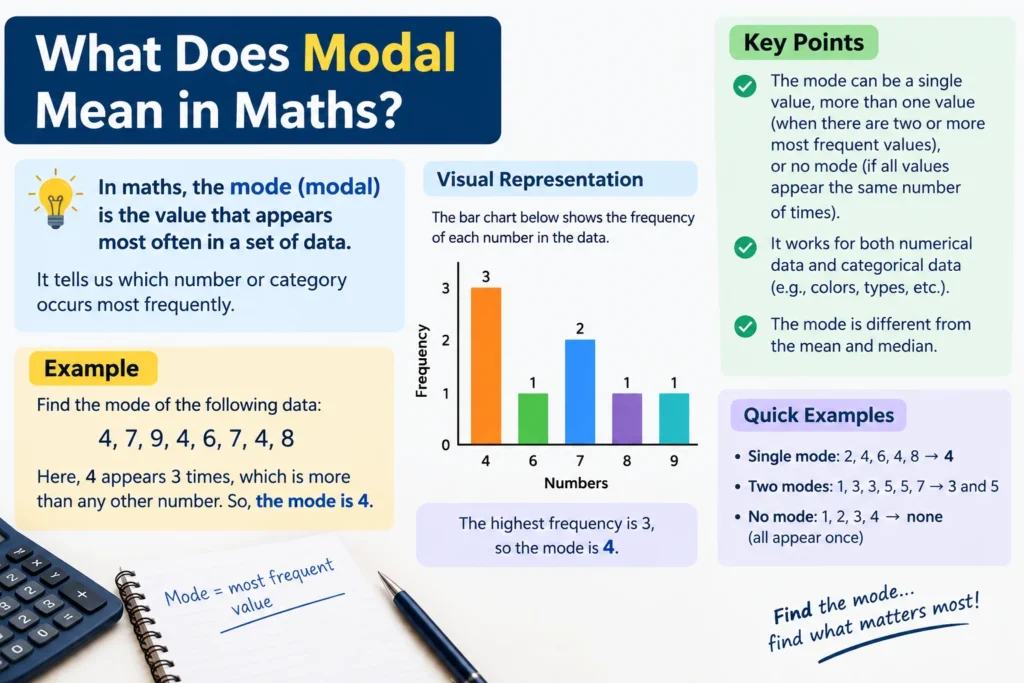
“Mode” means in math, “modal” just means “of the mode.” The mode is the value that shows up most often in a set of data. So when a teacher asks for “the modal number” or “the modal class,” they’re asking for the same thing as “the “mode”—the most frequent value.
That’s it. No hidden trick. If you’ve been staring at a worksheet wondering whether “modal” is some separate concept from “mode,” it isn’t. They’re used interchangeably, and once you can spot repetition in a list of numbers, you already know how to find it.
Mode vs. modal: is there a difference?
Not really. “Mode” is the noun (the value itself). “Modal” is the adjective form, usually attached to a word like number, value, or class—as in “the modal value is 7” or “identify the modal class.” ” You’ll see both terms on exam papers depending on the board, so it’s worth being comfortable with either phrasing.
Take this data set:
2, 3, 3, 4, 5, 5, 5, 6
Count how many times each number appears. The number 5 shows up three times, more than anything else. So:
- The mode is 5
- 5 is also called the modal value or modal number
Same answer, different label.
How to find the mode, step by step
- List out every value in the data set (or use a frequency table if one’s given).
- Count how often each value appears.
- Pick whichever value has the highest count. That’s your mode.
It works with words too, not just numbers. If a class votes on a favorite fruit and “apple” gets the most votes, apple is the mode even though it’s categorical, not numerical. That’s actually one thing that makes mode different from mean and median: it’s the only average that works on non-numeric data.
Modal, mean, and median: how they fit together
Mode is one of three common “averages” taught together in UK maths (mean, median, and mode), and mixing them up is probably the single most common mistake students make on this topic.
- Mean: Add everything up, divide by how many values there are.
- Median: Put the values in order, and find the middle one.
- Mode: Find whichever value repeats the most.
I’ve watched students confidently calculate a mean and label it “the mode” purely because it was the number they’d already worked out. If a question specifically says “modal” or “mode,” it wants the most frequent value, not an average you calculated some other way.
What if nothing repeats, or more than one thing does?
Two situations trip people up here:
No mode at all. If every value in a data set appears exactly once, there’s simply no mode. That’s a valid answer you’re not missing something.
More than one mode. If two values are tied for most frequent, the data set is bimodal (two modes). If three or more values tie, it’s multimodal. For example, in 1, 1, 2, 3, 3, 4, both 1 and 3 appear twice, so the modes are 1 and 3.
Grouped data and the modal class. With continuous data (heights, ages, and exam scores grouped into ranges), you usually can’t pick out a single repeated value. Instead, you identify the modal class—the group or range with the highest frequency. It’s the same idea, just applied to a bucket of values rather than one exact number.
A real example
Say a small business tracks shoe sizes sold in a week: 6, 7, 7, 8, 8, 8, 9, 9, 10. Size 8 sold three times more than any other size. That’s the modal size, and it’s genuinely useful information: it tells the shop which size to stock more of. This is where mode earns its keep outside the classroom; it’s less about precision and more about spotting what’s most common, which is exactly why retailers, pollsters, and researchers reach for it constantly.








1 thought on “What Does “Modal” Mean in Math?”