Decimal to BCD Encoder: A Practical Guide for Students
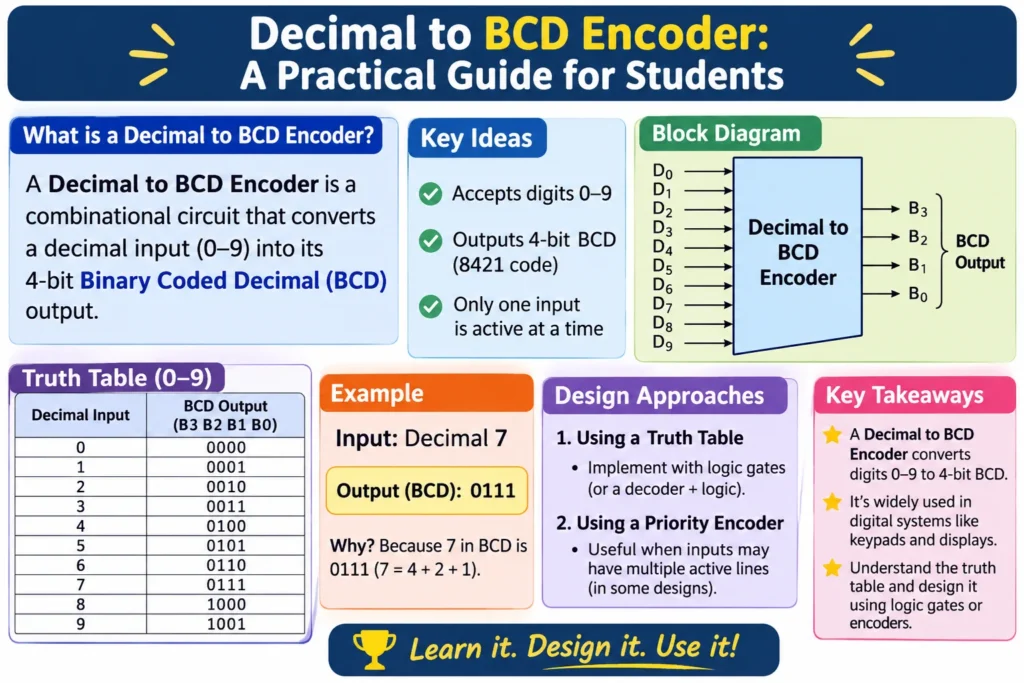
Press 7 on a calculator, and something inside has to turn that key press into bits. A decimal to BCD encoder does that job. It watches ten input lines, one for each digit from 0 to 9, and outputs a 4-bit binary code. If you’re taking digital logic, this circuit shows up in exams, lab sheets, and real keypad designs. Let’s walk through it from the code table down to the gates.
What the Circuit Actually Does
BCD stands for binary-coded decimal. Every decimal digit gets its own 4-bit group, and only the patterns 0000 through 1001 are valid. The other six, 1010 to 1111, never appear in proper BCD.
An encoder works in the opposite direction from a decoder. A decoder takes a binary code and lights one of many lines. Here you start with one active line out of ten and finish with four output bits. Picture a keypad where each key has its own wire. Press 6, and the outputs read 0110.
The BCD Code Table
| Digit | Y3 | Y2 | Y1 | Y0 |
|---|---|---|---|---|
| 0 | 0 | 0 | 0 | 0 |
| 1 | 0 | 0 | 0 | 1 |
| 2 | 0 | 0 | 1 | 0 |
| 3 | 0 | 0 | 1 | 1 |
| 4 | 0 | 1 | 0 | 0 |
| 5 | 0 | 1 | 0 | 1 |
| 6 | 0 | 1 | 1 | 0 |
| 7 | 0 | 1 | 1 | 1 |
| 8 | 1 | 0 | 0 | 0 |
| 9 | 1 | 0 | 0 | 1 |
The bit weights are 8, 4, 2, and 1, so this format is also called the 8421 code. Each output bit simply adds its weight when it equals
How the Gate Logic Works
Read the table one column at a time and ask which digits turn that output on.
- Y3 (weight 8) is high for 8 and 9, so Y3 = D8 + D9
- Y2 (weight 4) is high for 4, 5, 6, and 7, so Y2 = D4 + D5 + D6 + D7
- Y1 (weight 2) is high for 2, 3, 6, and 7, so Y1 = D2 + D3 + D6 + D7
- Y0 (weight 1) is high for 1, 3, 5, 7, and 9, so Y0 = D1 + D3 + D5 + D7 + D9
Each output is an OR gate fed by the matching input lines. Four gates, no inverters. Digit 0 needs no wire at all: when nothing else is active, every output stays at 0000. Exam questions love that detail.
There’s a catch, though. This basic design assumes one key at a time. Press 3 and 4 together and the gates output 0111, which is the code for 7. Garbage in, garbage out.
Priority Encoders and the 74147
Real hardware fixes the double-press problem with priority. The 74147 is a 10-line to 4-line priority encoder. When several inputs go active, it encodes the highest-numbered one and ignores the rest.
Two quirks trip students up. First, the inputs are active-low, so a pressed key pulls its line to 0. Second, the outputs are active-low as well, which means you get the inverted code. Digit 5 comes out as 1010, not 0101. Put four inverters on the outputs to get true BCD. And the chip has no input for 0: with every input high, the outputs read 1111, which inverts to 0000.
Worked Example: Encoding 259
BCD handles one digit at a time:
- 2 becomes 0010
- 5 becomes 0101
- 9 becomes 1001
Put them together, and 259 reads 0010 0101 1001. Straight binary for 259 is 100000011, only nine bits, while BCD takes twelve. That costs extra storage, but it skips the conversion arithmetic and makes display drivers simple. It’s why digital clocks, meters, and calculators still lean on it.
Mistakes Students Make
Reading 1010 through 1111 as valid BCD is the classic one. They aren’t. Another is confusing active-low with active-high on the 74147, then wondering why every answer looks flipped. Some students also read BCD as plain binary: 0001 0000 is decimal 10, not 16. And plenty add a dedicated gate for digit 0, which the design doesn’t need.
FAQ: Decimal to BCD Encoder Questions
Q: What is a decimal to BCD encoder?
A: It’s a digital circuit that converts one active decimal input line (0 to 9) into a 4-bit binary-coded decimal output.
Q: How many inputs and outputs does it have?
A: Ten inputs, one per digit, and four outputs. Digit 0 often has no physical input, since all-zero outputs already represent it.
Q: What’s the difference between a decimal-to-BCD encoder and a priority encoder?
A: A basic encoder breaks if two inputs are active at once. A priority encoder, like the 74147, picks the highest-numbered active input and encodes only that one.
Q: Why does the 74147 output look inverted?
A: Its outputs are active-low. Add inverters to read normal BCD.
Q: Is BCD the same as binary?
A: No. BCD encodes each decimal digit separately in 4 bits, while binary converts the entire number as one value.
Wrap-Up
A decimal to BCD encoder boils down to four OR gates and one clear table. Learn the 8421 weights, write each output as an OR of the digits that need it, and remember that the 74147 flips everything to active-low. Try encoding your phone’s last four digits by hand, then check each group against the table.