
ReferralCandy vs. Friendbuy vs. Ambassador: Which Referral Marketing Platform (and API) Fits Your Business?
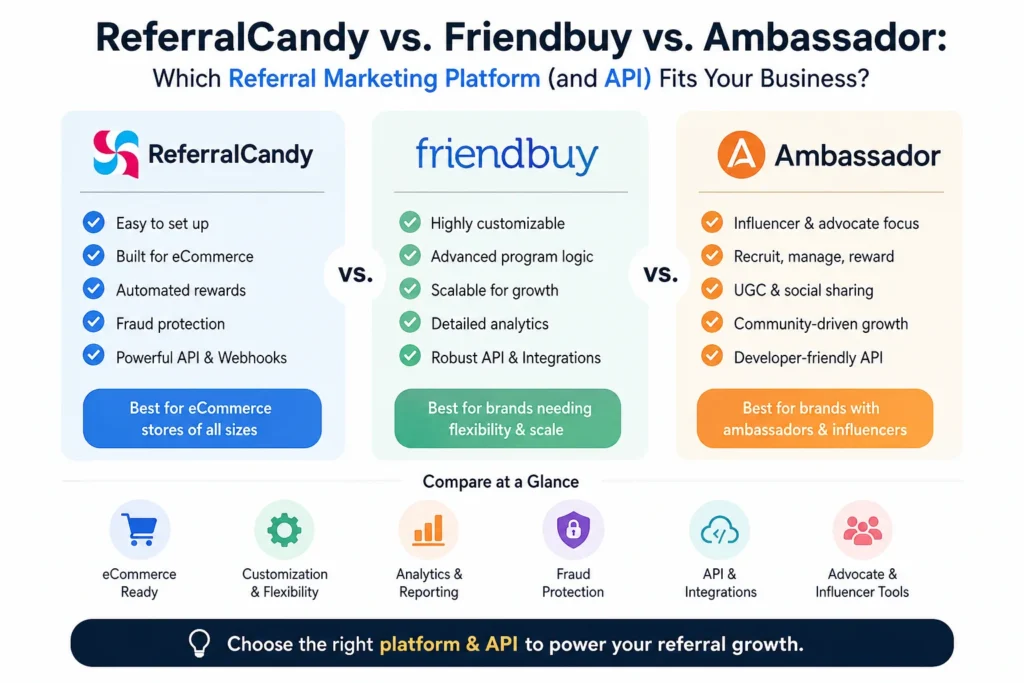
If you’re comparing referral marketing platforms, you’ve probably run into the same three names over and over: ReferralCandy, Friendbuy, and Ambassador. They all promise the same outcome, more customers from word of mouth, but they’re built for different-sized businesses, different budgets, and different levels of developer involvement. Here’s how they actually stack up, including what each one’s API can (and can’t) do for you.
Quick Comparison
| ReferralCandy | Friendbuy | Ambassador | |
|---|---|---|---|
| Best for | Shopify/ecommerce stores, small to mid-size | DTC/enterprise brands with dev resources | Enterprise, multi-channel ambassador programs |
| Starting price | $39/mo + success fee | ~$249/mo, custom, no success fee | ~$1,000/mo, custom quote |
| Pricing model | Flat fee + commission on referred sales | Flat platform fee (loyalty add-on extra) | Flat fee, quote-based |
| Free trial | 7 days, no permanent free tier | No, sales-led | No, sales-led |
| API access | Included on every plan | REST API, deep data-warehouse integrations | API-first, broad app integrations |
| Loyalty program built in | No (referral + affiliate only) | Yes, as paid add-on | Add-on varies by plan |
ReferralCandy: The Ecommerce Default
ReferralCandy is built almost entirely around Shopify and WooCommerce stores that want to get a referral program live fast, without a developer. Every plan, from Basic to Enterprise, includes the same toolkit: unlimited referral campaigns, unlimited affiliate campaigns, custom coupon codes, and <cite index=”6-1″>full API access alongside connections to Klaviyo, Recharge, Tremendous, and more than 20 other apps</cite>. Nothing gets locked behind a higher tier; you’re only paying for a lower success fee and better support as you move up.
That pricing structure is worth understanding before you sign up. <cite index=”6-1″>Plans run Basic at $39/month plus a 10.5% success fee, Grow at $79 plus 3.5%, Scale at $249 plus 1.5%, and Enterprise at $799 plus 0.25%, with the success fee applying only to a referred customer’s first three orders</cite>. In plain terms: the base fee buys you the software, and the percentage buys you a lower cut as your referral-driven revenue grows. There’s <cite index=”1-1″>a 7-day free trial and no permanent free tier</cite>, so budget for billing to start quickly once you’re testing it live.
On the API side specifically, Capterra’s feature breakdown notes <cite index=”9-1″>that ReferralCandy’s API lets you integrate the platform with other systems and databases</cite>, which covers most standard use cases like syncing referral data into your CRM or triggering custom reward logic. It’s not the deepest API of the three, but it doesn’t need to be for a typical DTC store.
Where it falls short: there’s no built-in loyalty or points system, so if you eventually want tiered VIP rewards alongside referrals, you’ll be adding a second tool.
Friendbuy: Built for Scale, Priced for It
Friendbuy plays in a different weight class. Its client list includes brands like <cite index=”11-1″>Dollar Shave Club, Away, Casper, and Outdoor Voices, plus Fortune 100 companies such as Walmart, Intuit, Disney, and Nestle</cite>, and its pricing reflects that positioning. Instead of a percentage-based success fee, Friendbuy charges a flat platform fee, with <cite index=”14-1″>custom pricing reported to start around $249 a month and scale up to enterprise-level contracts, running on annual terms at most tiers</cite>. If you also want the loyalty module, expect that to raise the bill further; <cite index=”13-1″>tiered loyalty has been reported at roughly $1,000 a month on top of the base referral quote</cite>.
What you get for that price is real integration depth. <cite index=”10-1″>Friendbuy offers API-based and third-party integrations across platforms like Stripe, Segment, Klaviyo, Chargebee, and ReCharge, automating reward payouts and centralizing referral data</cite>. Independent buyer research puts it plainly: <cite index=”14-1″>Friendbuy’s core strength is API depth and customization, but getting full value out of it requires developer involvement; brands without engineering resources tend to struggle with the advanced features they’re paying for</cite>.
Who it’s actually for: the same research suggests <cite index=”14-1″>Friendbuy’s sweet spot is a premium DTC brand doing $5 million or more in GMV that genuinely uses the referral module, the loyalty module, and the API together</cite>. If that’s not you yet, you’d likely be overpaying for capacity you won’t touch.
Ambassador: The Enterprise, API-First Option
Ambassador positions itself as the most flexible and customizable platform of the three, and the pricing matches that ambition. One 2026 buyer’s comparison lists <cite index=”21-1″>Ambassador’s custom enterprise pricing starting around $1,000 a month and scaling with usage, with the review naming Ambassador the top choice largely because of its API-first approach and advanced management tools</cite>. There’s no public self-serve pricing page; quotes are handled through sales.
Where Ambassador stands out is breadth. It’s not limited to a single referral use case: <cite index=”17-1″>the platform tracks referral traffic, manages influencer marketing, and optimizes programs across industries, including IT, fashion, healthcare, retail, real estate, insurance, and hospitality</cite>, and <cite index=”17-1″>its API connects with tools like WooCommerce, Shopify, Sendgrid, Stripe, Mailchimp, and HubSpot</cite>. That range makes it a fit for companies running referral, affiliate, and ambassador programs side by side rather than a single Shopify widget.
Head-to-head buyer research backs this up on the service side too. In direct comparisons, <cite index=”25-1″>reviewers rated Ambassador higher than ReferralCandy on ease of use, ease of administration, and quality of ongoing support</cite>, though <cite index=”25-1″>Ambassador’s reviewer base skews far more toward larger companies, with only 47.9% classified as small businesses compared to 88.1% for ReferralCandy</cite>. That gap tells you a lot about which company each platform is actually designed for. One independent review also flags a real drawback worth budgeting around: <cite index=”17-1″>the software is priced at a premium, and the percentage-based referral commission share was called out as the main downside</cite>.
Which One Should You Actually Pick?
- Running a Shopify or WooCommerce store under a few million in annual revenue, with no in-house developer? ReferralCandy is the fastest path to a working program, and the success-fee structure means you’re not paying much until the referrals actually convert.
- Already doing $5M+ in GMV, want referrals and loyalty in one system, and have engineering support to use a deeper API? Friendbuy earns its price tag here.
- Running programs across referral, affiliate, and influencer channels at once, or operating outside pure e-commerce (healthcare, insurance, real estate)? The ambassador’s broader API and multi-program design fit that complexity better than either of the other two.









1 thought on “ReferralCandy vs. Friendbuy vs. Ambassador: Which Referral Marketing Platform (and API) Fits Your Business?”