
Great American Landscapes: 10 Places That Define the Country
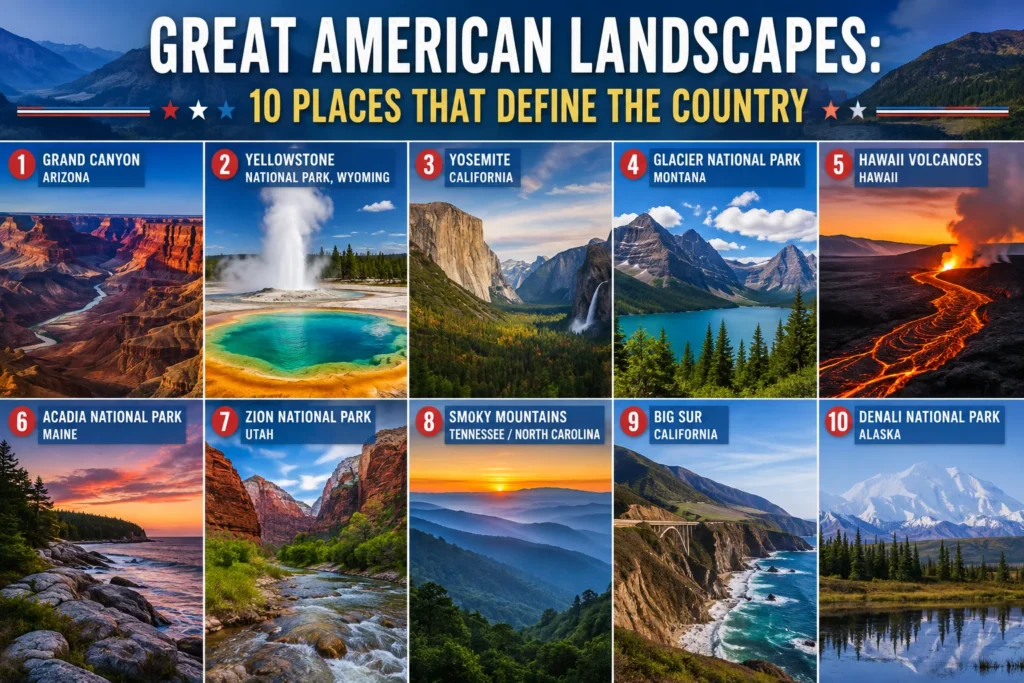
Standing at the rim of the Grand Canyon or watching Old Faithful erupt for the first time, you understand pretty quickly why people plan entire vacations around a single view. The United States has an unusually wide range of terrain packed into one country: deserts, glaciers, coral reefs, redwood forests, and canyons a mile deep. That variety is what makes “great American landscapes” such a broad, satisfying subject to explore.
This guide covers ten of the most iconic landscapes in the U.S., what makes each one worth the trip, and when to go.
What Makes a Landscape “Great”?
Not every scenic overlook makes this list. The places below share a few things in common: they’re geologically or ecologically significant, they’ve shaped American culture and identity, and they still look, more or less, the way they did before anyone built a road to reach them. Many are protected under the National Park Service, which manages 63 national parks and hundreds of other sites specifically to preserve landscapes like these for future visitors.
1. Grand Canyon, Arizona
Carved by the Colorado River over roughly six million years, the Grand Canyon stretches 277 miles long and reaches depths of over a mile. The South Rim stays open year-round and gets the bulk of visitors; the North Rim is quieter but closes in winter. Sunrise and sunset are when the canyon walls really show their color.
2. Yellowstone National Park, Wyoming/Montana/Idaho
Established in 1872, Yellowstone was the first national park in the world. It sits on top of a volcanic hotspot, which is why it has more geysers and hot springs than anywhere else on Earth. Old Faithful is the famous one, but Grand Prismatic Spring, with its rings of orange and blue, is arguably more striking in photos.
3. Yosemite Valley, California
Yosemite’s granite cliffs, including El Capitan and Half Dome, were shaped by glaciers. Spring is the best time to visit if waterfalls are the priority. Yosemite Falls and Bridalveil Fall run heaviest from April through June and can slow to a trickle by late summer.
4. Zion National Park, Utah
Zion’s red and cream sandstone canyons draw hikers to trails like Angels Landing and the Narrows, where the trail is the riverbed itself. The park has shifted to a shuttle-only system on the main canyon road during peak season, so plan around that if you’re driving in.
5. Great Smoky Mountains, Tennessee/North Carolina
The most-visited national park in the country, and it’s not close. The Smokies get their name from the natural fog that settles over the ridgelines, a result of humidity and vegetation rather than actual smoke. Fall foliage here rivals New England’s, usually peaking in mid-October.
6. Monument Valley, Arizona/Utah
The sandstone buttes of Monument Valley have appeared in more Western films than almost any other American landscape, largely thanks to director John Ford. It’s on Navajo Nation land, and the best way to see it up close is a guided tour led by a Navajo guide, which also supports the local community directly.
7. Acadia National Park, Maine
Acadia is where the granite coast of Maine meets the Atlantic. Cadillac Mountain is famous for being one of the first places in the U.S. to see the sunrise for part of the year. The park mixes rocky shoreline, dense forest, and small mountains in a compact area that’s easy to cover in two or three days.
8. Redwood National and State Parks, California
Home to the tallest trees on the planet, some over 350 feet, the redwoods along California’s north coast are old enough that a few were already centuries old when Rome fell. Walking among them, especially in fog, is a different kind of scenery than the canyons and peaks elsewhere on this list.
9. Badlands National Park, South Dakota
Layered rock formations, striped in red, yellow, and gray, spread across an otherwise flat prairie. The Badlands look almost lunar, and the erosion that carved them is ongoing, which means the landscape is technically changing shape a little every year.
10. Glacier National Park, Montana
Glacier is losing what gave it its name. Of the roughly 80 glaciers present in the 1850s, fewer than 25 remain today, and most are much smaller than they used to be. Going-to-the-Sun Road, which crosses the Continental Divide, is one of the more dramatic drives in the national park system, though it’s only fully open a few months a year due to snow.
Planning a Landscape-Focused Trip
A few practical notes if you’re building a trip around several of these:
- Book campsites and lodges early: Popular parks fill up 6 to 12 months ahead for peak-season dates.
- Shoulder seasons often beat summer: Late spring and early fall usually mean smaller crowds, milder temperatures, and, in many parks, better light for photos.
- Check road and trail closures before you go: High-elevation roads like Going-to-the-Sun in Glacier or Trail Ridge Road in Rocky Mountain National Park are seasonal.
- Consider an America the Beautiful pass. if you’re visiting more than two or three federal sites in a year. It covers entry to national parks, forests, and other federal lands for one flat annual fee.